Content Quality
Part of Search intent and topic planning
Grouping queries that need one useful page
Group search phrases by the answer a reader needs, then use a same-page test to decide which variants belong together and which need separate pages.
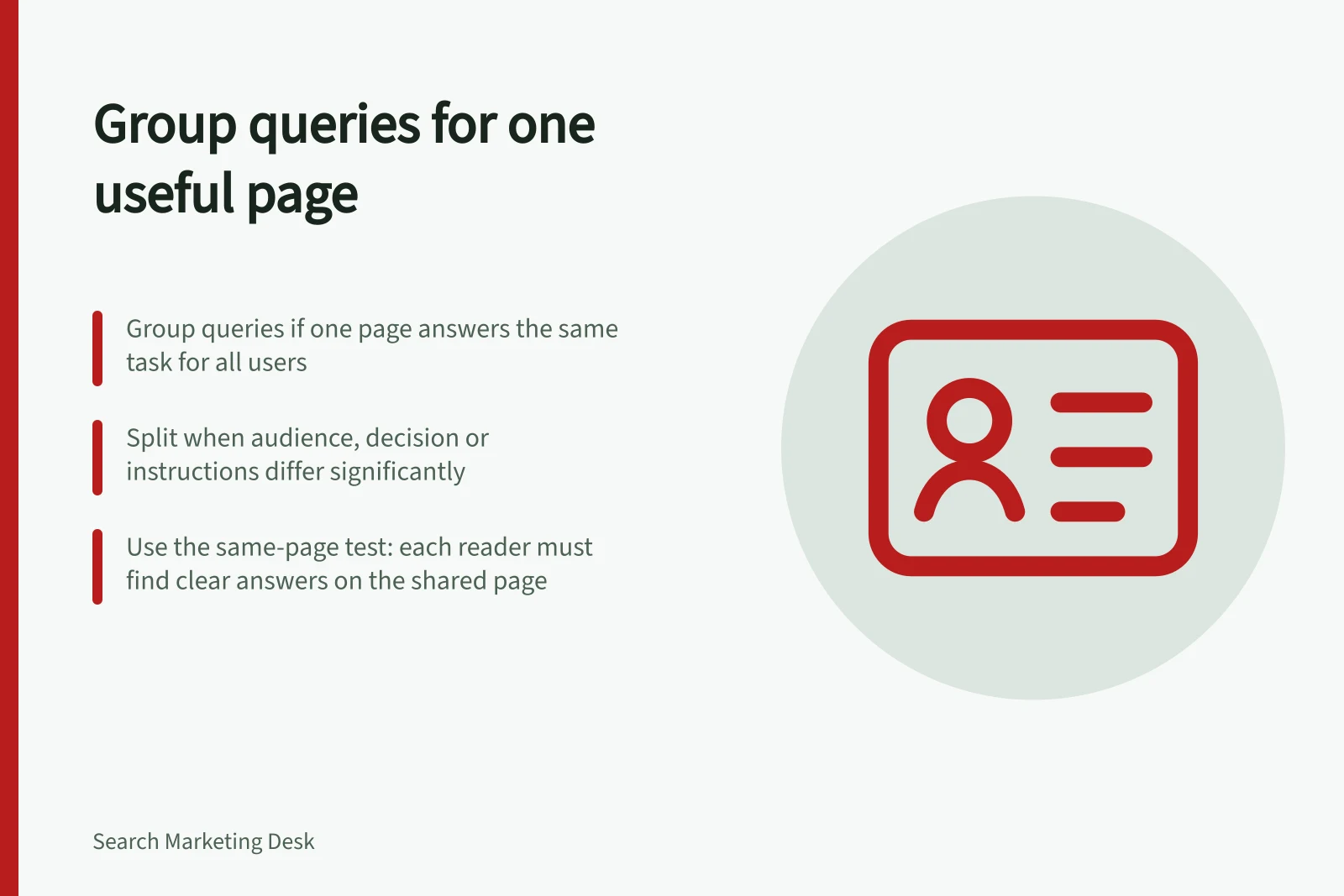
Group queries when one page can give each searcher a complete answer to the same underlying task. Split them when the audience, decision, instructions or evidence changes enough that a shared page would be difficult to use. Similar words are a starting point, not the grouping rule.
Make an answer card for each query
For each candidate phrase, record the likely reader question, the answer required and any condition that changes it. “How to choose appointment booking software” and “appointment booking software selection criteria” could share an answer about evaluating options. “How to change appointment cancellation settings” calls for operational instructions. It belongs to a different task even though all three phrases mention appointment software.
| Query | Reader task | Answer needed | Possible page |
|---|---|---|---|
| How to choose appointment booking software | Evaluate a category | Criteria and trade-offs | Selection guide |
| Appointment booking software selection criteria | Evaluate a category | The same criteria in clear language | Selection guide |
| Change appointment cancellation settings | Perform a setup task | Verified, product-specific steps | Separate help page |
Leave a query unassigned when its meaning is uncertain. Shared wording alone is not a reason to force it into a group.
Apply the same-page test
Imagine a reader landing directly on the proposed page from each query. Can they find the promised answer under a sensible heading, with the required detail and qualifications? If so, the queries may belong together. If one reader needs a different comparison, set of steps or geographic rule, separate the task.
Keep a group together when differences are mainly wording, such as a synonym or a beginner’s phrase for the same decision. Write naturally rather than repeating every variant; the page still needs to answer the shared task.
Avoid near-identical pages that repeat the same answer under different titles. Equally, do not stretch one guide across unrelated questions merely to reduce the page count. The proposed page must remain useful to each reader in the group.
Check the boundary against existing pages
Compare the proposed group with the site’s current and planned pages. If one page already answers the task, assign the group to it and improve any missing detail. If two pages appear to claim the same task, decide which one should give the main answer before adding more copy.
Canonical settings address duplicate URLs; they do not establish an editorial purpose for each article.
If Search Console data is available, use it as one input when checking which pages appear relevant to a query. Treat it as evidence to review, not proof that other variants lack an audience.
Finish a group with a one-sentence page promise, the questions it must answer and the related questions it deliberately leaves out. If the exclusions are hard to explain, revisit the group.