Content Quality
Part of Search intent and topic planning
Distinguishing an information query from a buying comparison
Use the answer a reader needs, query clues and existing pages to decide whether a search calls for an explanation or a buying comparison.
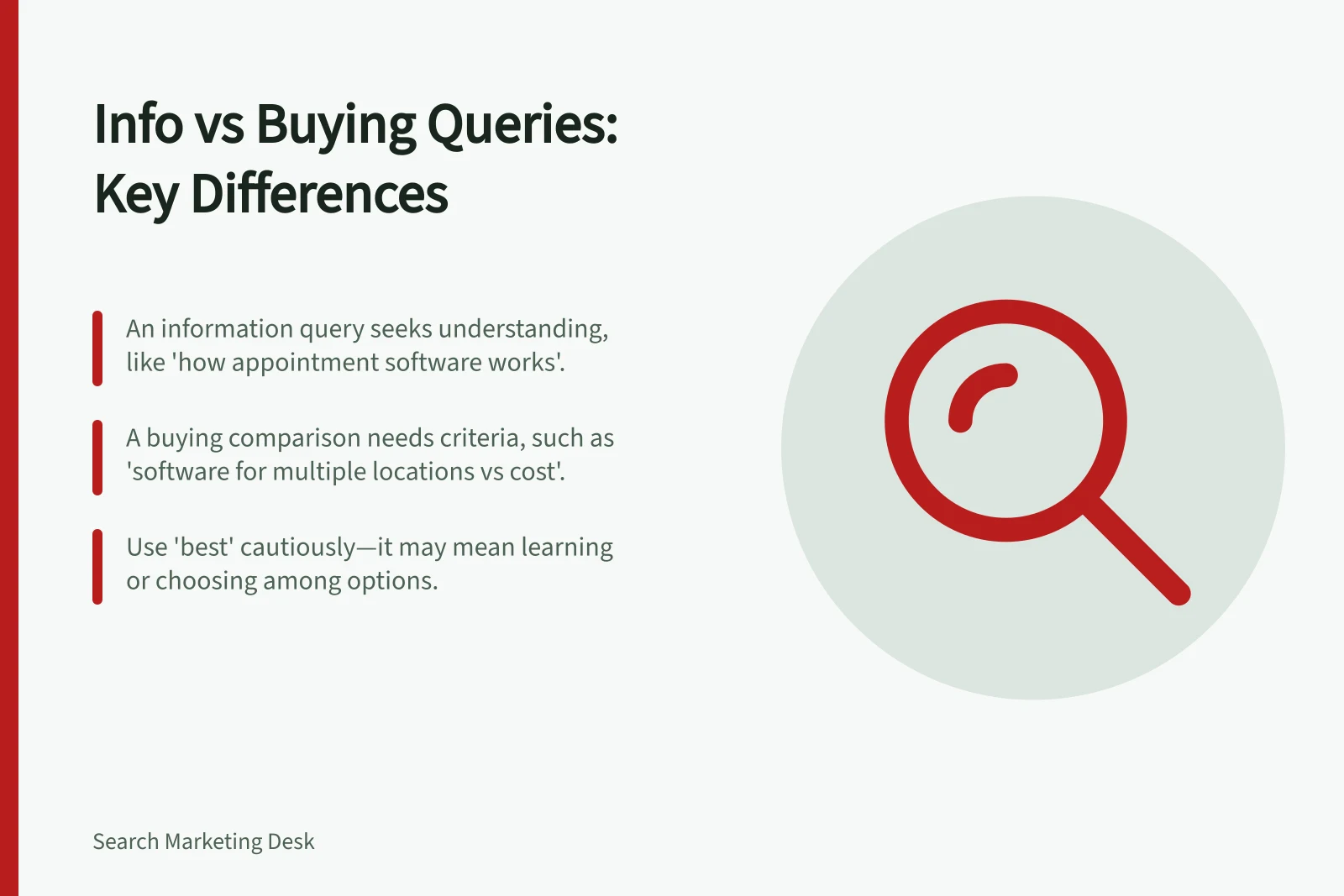
An information query asks for understanding; a buying comparison asks for help choosing among options. Words alone may not settle which task a person has. Decide by the answer they need next: an explanation of how something works, or criteria and trade-offs for comparing choices.
Read the decision behind the phrase
Rewrite the query as a reader question. “What is appointment booking software?” suggests a definition, common uses and limits. “Appointment booking software compared” suggests a choice among alternatives. Neither phrase tells you the reader’s budget, industry or preferred provider.
Modifiers are clues, not verdicts. “How”, “what” and “why” often point towards learning; “compare”, “versus” and named alternatives often point towards choosing.
“Best” is less clear: a reader may want a shortlist or may still be learning which criteria matter. “Appointment booking software for several locations” could require an explanation, a comparison or information about a particular offer, depending on the fuller question.
If the reader needs… / The page should mainly provide…
- A concept explained
- A direct definition, how it works and relevant limits.
- A way to evaluate options
- Comparable criteria, meaningful differences and questions to verify.
- A particular offer assessed
- Accurate details of that offer, including exclusions and conditions.
Test the answer against other clues
For an ambiguous phrase, describe a satisfactory answer in one sentence. Then ask what would still be missing. A definition that stops just before the reader needs to choose may benefit from comparison criteria. A comparison that assumes unfamiliar terms may need a short explanation first.
Current search results in the market served can show whether visible pages tend to explain, compare or sell. They offer a clue, not proof that every searcher has the same intent. Customer questions can reveal what people still need to know before making a choice.
Existing query data may show which pages were shown for a query, which can reveal a mismatch.
Decide whether one page serves both tasks
One page may work when a short explanation naturally leads into a focused comparison for the same audience. Define the subject, then show the criteria that affect a choice. For example, a comparison for a business with several locations could make location support a criterion.
Separate pages may work better when the explanation is broad but the comparison needs a different audience or evidence. For example, a general guide to appointment software could explain the category, while a comparison for a business with several locations could address requirements specific to that situation. Those are possible page purposes, not findings about providers.
State each proposed page’s promise in one sentence. If both promises and their required answers are effectively the same, reconsider the split.