Content Quality
Part of Search result changes and AI features
Improving content clarity without writing for speculative ranking tricks
Edit pages for clear answers, accurate limits and useful structure while checking AI-search tactics against documented guidance.
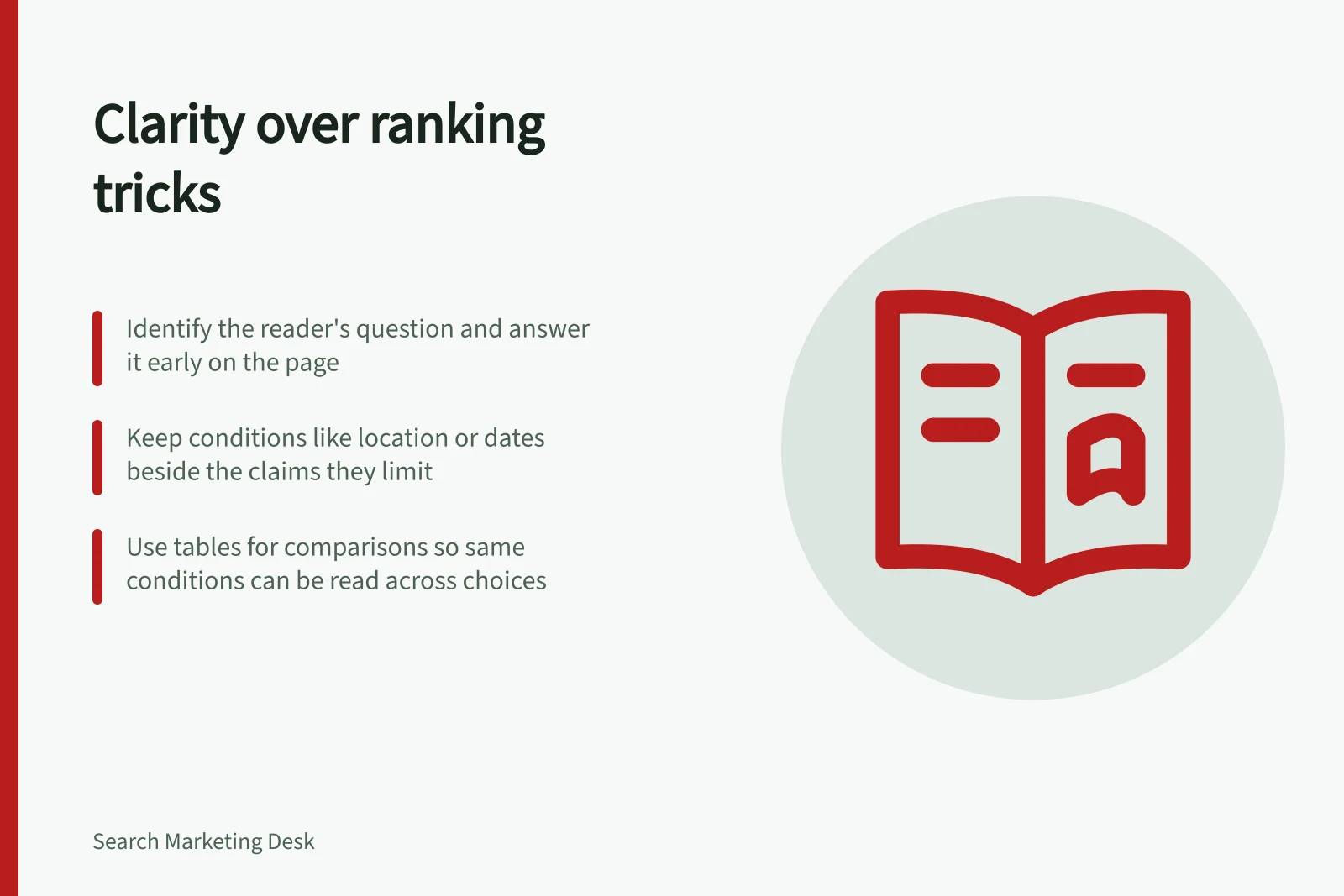
Improve a page by making its answer easier to find, understand and use. Identify the reader's question, give the answer early, keep conditions beside the claims they limit, and remove repeated material. These edits have a clear reader benefit even when no ranking or AI-feature outcome can be promised.
Identify the page's decision
Write one sentence describing what a direct visitor should be able to do after reading. A service page might help someone decide whether the business can handle a job in their area. A guide might help them choose between approaches. Read the title, opening and headings against that promise.
If the title promises an answer the page does not supply, provide a verified answer or narrow the title. If the opening delays the answer with background, bring the answer and its main limit forward.
“Available across Australia” needs correction at the claim itself when an offer covers only selected places.
Before and after: correcting geographic claims
- BeforeAvailable across Australia
- AfterAvailable in NSW, VIC, QLD and ACT – not nationwide
Edit the point where readers lose the thread
Use five checks:
- Answer:Is the central answer near the top?
- Meaning:Are essential terms clear enough to use the advice?
- Conditions:Are dates, geography, product versions and exclusions beside the claims they change?
- Sequence:Does each section answer a distinct follow-up question?
- Action:Can the reader tell what to check or do next?
One question may need only a short paragraph. A comparison may need a table so the same conditions can be read across choices. Choose the format from the task.
Google says there are no additional technical requirements for eligibility to appear as a supporting link in AI Overviews or AI Mode.
For example, “Check whether the page is current” becomes more useful when it names what can change, such as availability, coverage or an applicable date, and explains how an outdated detail could affect a choice.
Five checks to edit where readers lose the thread
- AnswerIs the central answer near the top?
- MeaningAre essential terms clear enough to use the advice?
- ConditionsAre dates, geography, product versions and exclusions beside the claims they change?
- SequenceDoes each section answer a distinct follow-up question?
- ActionCan the reader tell what to check or do next?
Key facts about AI Overviews and AI Mode eligibility
- No technical requirements for AI Overviews
- Pages are eligible without special technical setup
- Google’s spam policies apply
- Manipulating generative AI answers may lead to lower ranking or exclusion
- Original information valued
- Content with verified service boundaries or documented processes helps users
Keep evidence and limits visible
Mark claims a visitor might rely on: eligibility, specifications, prices, timing, comparisons and outcomes. Check each against an underlying record or exact authoritative source. If the evidence supports a narrower statement, write that statement. Do not turn one internal observation into a market-wide rule.
Original information can help when its basis is clear. A verified service boundary or documented process may resolve a visitor's uncertainty. If the record is unavailable, leave out the assertion.
Google asks creators to consider whether their content offers useful original information or analysis and helps readers achieve their goal.
Judge tactics by the reader benefit
Google says existing Search guidance applies to AI Overviews and AI Mode. Specific optimisation isn't required for these features.
Keep an element only when it helps visitors find, understand or use the answer. Google's spam policies cover attempts to manipulate generative AI answers in Search; sites that breach its policies may rank lower or not appear in results.
Clear writing and technical eligibility do not guarantee that Google will crawl, index or show a page. After an edit, check whether the page now answers its reader's question. Later page, query and action data may suggest what to inspect next, but a movement alone will not establish that the edit caused it.
Evaluating tactics by reader benefit
- Pros
- Improves clarity, accuracy and usability for real users
- Cons
- Speculative SEO tricks may violate spam policies and harm visibility