Content Quality
Part of Search content quality reviews
Improving a guide with original evidence
Choose evidence that helps a reader decide, record how it was obtained and state the limits of what it shows.
Add original evidence when a guide needs more than a summary of familiar advice. Begin with the decision it promises to help the reader make. Then find a verifiable observation, example, measurement or explanation that clarifies that decision. Originality alone is not enough: the evidence must be relevant and accurately described.
Find where evidence would help
Mark recommendations that ask the reader to trust a conclusion without showing why. “Check the process before choosing” may be reasonable, but it is more useful when the guide shows what to check and how the result affects the choice. A documented workflow, comparison of conditions or worked example may supply that detail.
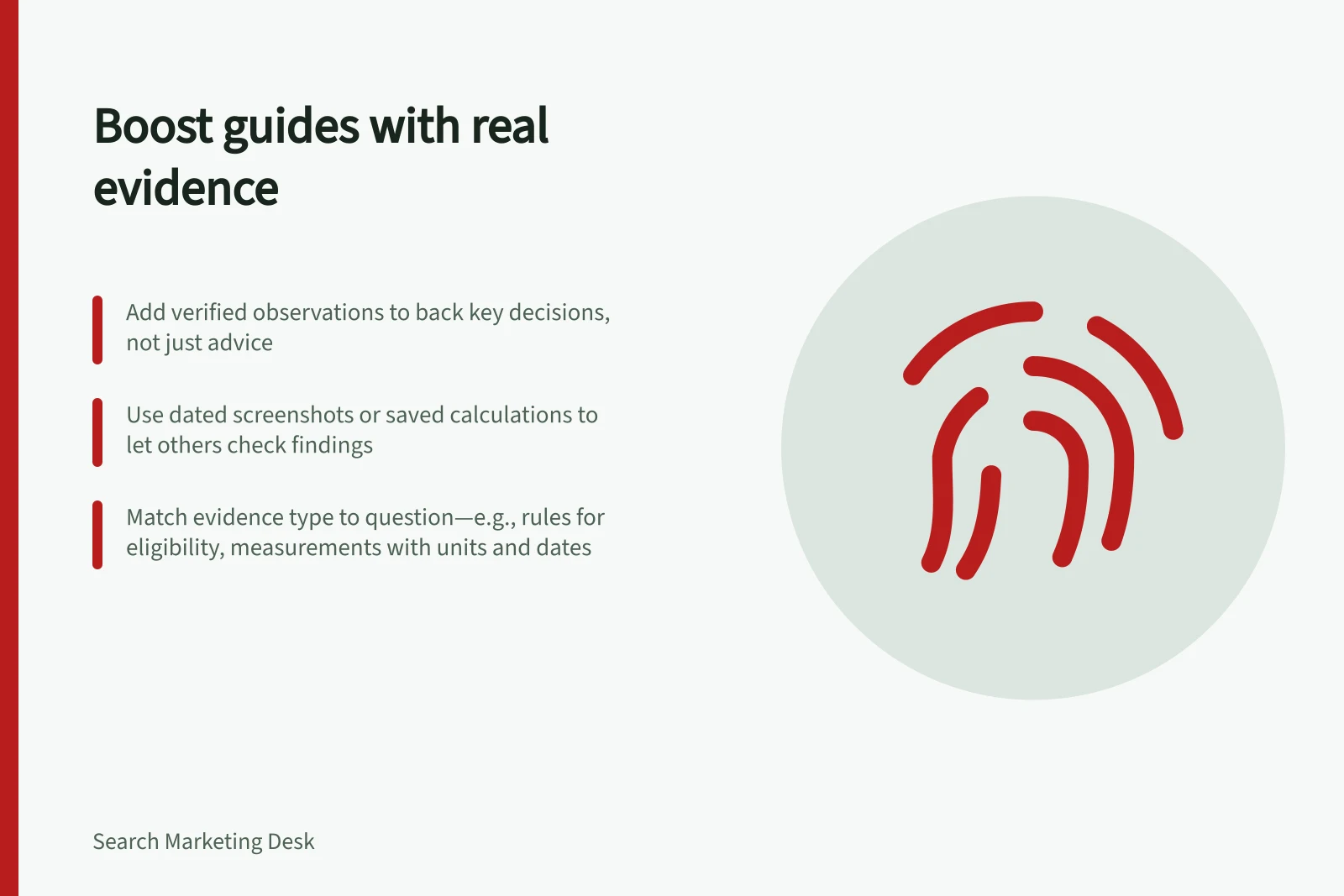
Choose the form of evidence to suit the question. A setup guide could show a verified sequence, with product version and date. A service guide could explain confirmed eligibility rules through an example. A comparison could apply the same stated criteria to each option.
Describe only work actually done and facts that can be checked.
For each candidate finding, identify the record that would let another editor verify it: a dated screenshot for a changing setting, a saved calculation for a measurement, or a written account of the steps followed for a workflow. Choose a record that supports the point, and note any gaps before drafting.
Keep a record that supports the wording
Before writing a finding, record what was examined, when, under which conditions and by whom. Retain enough underlying material for another editor to check the conclusion. A useful note identifies the item examined, method, observation and limits.
Do not turn one observation into a general rule. One confusing step in an example may justify explaining that step; it does not show that every user encounters the problem. If an internal sample is small or chosen for convenience, state that limit beside the finding.
Evidence available / Appropriate use in a guide
- Confirmed operating rule
- Explain whom it applies to and any exception.
- Documented example
- Show how the rule works in one situation.
- Recorded measurement
- Give the method, unit, date and relevant conditions.
- Customer question
- Clarify the answer; do not infer prevalence without data.
Turn evidence into a better answer
Place evidence where the reader faces the decision. Explain what it shows, what it cannot show and how it affects the next step. Use a table when readers compare the same dimensions; a short example may be clearer for one easily misunderstood condition.
Check every number, label and qualification against the underlying record. Attach changing details, such as availability or a software setting, to the relevant date or version. If the record cannot be checked or does not support the planned wording, narrow the claim or omit it.
The main answer should remain easy to follow after evidence is added. If new material answers another question, give it a more suitable place rather than burying the guide’s decision.