Content Quality
Search content quality reviews
Review existing pages for complete answers, supported claims, useful evidence and a clear editorial action.
A search content quality review asks whether an existing page gives its intended reader a clear, accurate and useful answer.
State the page’s job, read the answer as a direct visitor, check material claims and choose an editorial action. Search traffic can help select pages to inspect; it cannot judge the answer on its own.
Choose pages and define their jobs
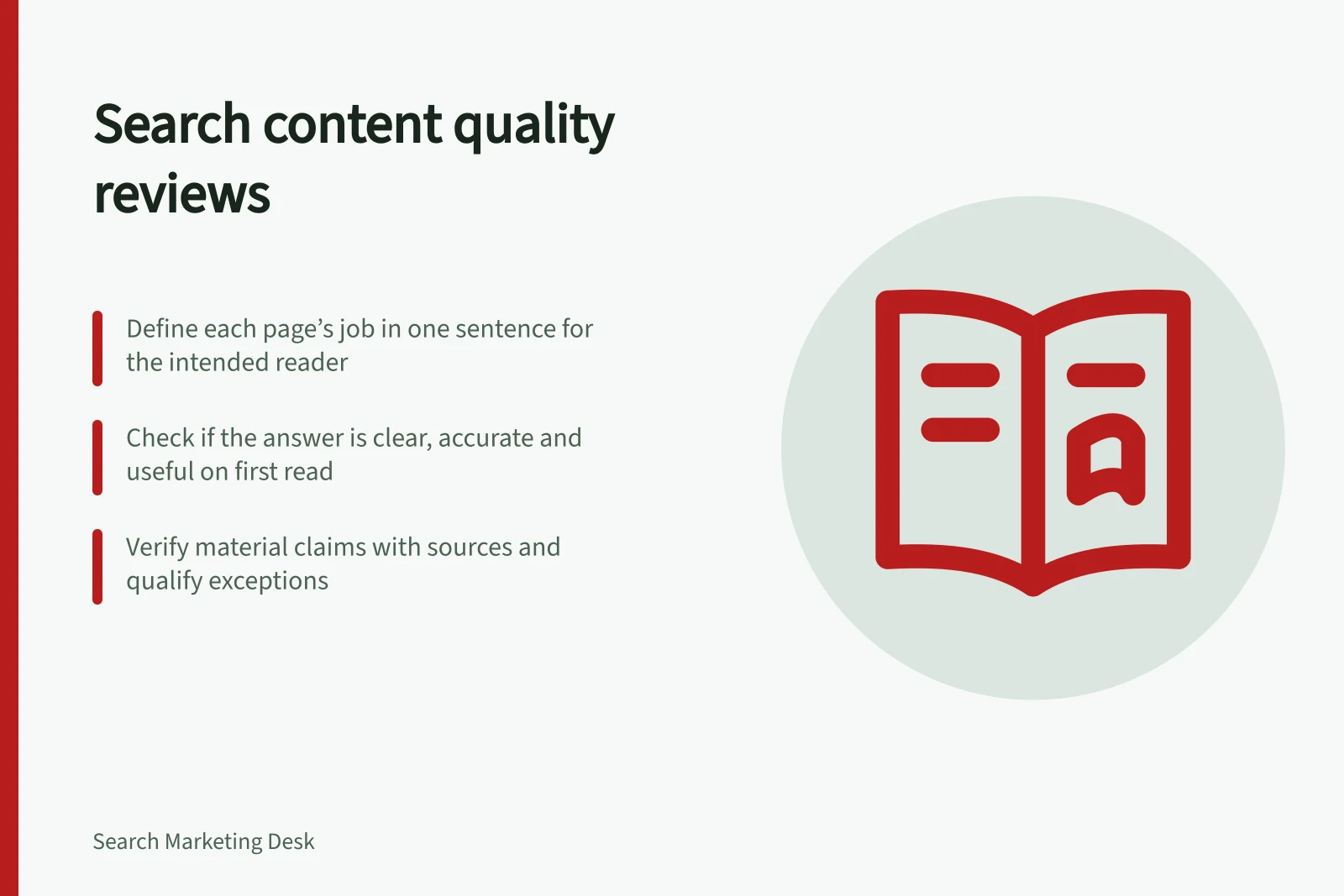
Begin with pages that support a customer task: understanding an offer, comparing options or solving a problem. For each page, write one sentence stating whom it helps and what they should be able to do after reading it. Compare that promise with the title, opening and main sections.
A page can be brief and complete; another can be long yet leave its central question unanswered. Review the information the reader needs for the decision, including conditions that change the answer.
Customer enquiries and on-site feedback can expose uncertainty. In a Search Console property you control, page and query data may suggest a mismatch worth investigating.
Read the page as a direct visitor
Open the page without assuming the reader came through a main guide. Can they tell near the top what the answer is and whether it applies to them? Read each section against its heading. If a section merely repeats the introduction, give it a useful job or remove it.
Review question / Editorial response when it fails
- Does the opening answer the promised question?
- State the answer and its essential limit early.
- Can the reader use each section?
- Add the missing step or condition, or cut the section.
- Are material claims supported?
- Verify and qualify them, or remove them.
- Does the page contribute useful evidence or analysis?
- Add verifiable detail where it helps the decision.
- Is this the right page for the task?
- Compare nearby pages before expanding or creating a URL.
A favourable review does not guarantee indexing or a search position.
Editorial Response to Common Page Failures
- Does the opening answer the promised question?State the answer and its essential limit early.
- Can the reader use each section?Add the missing step or condition, or cut the section.
- Are material claims supported?Verify and qualify them, or remove them.
- Does the page contribute useful evidence or analysis?Add verifiable detail where it helps the decision.
- Is this the right page for the task?Compare nearby pages before expanding or creating a new URL.
Check trust and editorial craft
Ask a trusted reader who is not connected with the site to assess the page honestly. Give them the intended reader task, then ask whether the page answers it clearly and what remains uncertain. An outside view can reveal assumptions familiar to the people who wrote or maintain the page.
Check whether the page offers something valuable beyond material already available elsewhere. When it draws on other sources, look for useful added analysis or information rather than copying or simply rewriting them. Consider whether the page is complete enough for its subject and whether its detail helps readers make sense of the answer.
Review the title and presentation as part of the quality check. The title should describe the page usefully, without sensational or exaggerated wording; also look for spelling or style problems and signs that the work was assembled carelessly or produced at scale without enough attention to the individual page.
Inspect evidence and qualifications
Mark statements that could affect a choice: availability, performance, compatibility, dates, prices, comparisons and promised outcomes. Check the source or underlying record for each statement against its precise wording. Keep an exception beside the claim it qualifies. If a service operates in selected areas, the page should not promise service throughout Australia.
First-hand information can improve an answer when its method and limits are clear. A documented customer question may justify clarifying a page; it does not show how often all customers ask it. A small internal check may illustrate a process without establishing a general market claim.
Self-assessment does not require an invented experience or a fixed amount of added text.
Where an author’s expertise or an expert review is relevant, make the basis for that credibility clear and accurate; do not add credentials or review claims that cannot be substantiated.
Assess credibility signals
Make sourcing transparent by linking material claims to relevant sources or records, and distinguish evidence from interpretation.
Make a page-level decision
Record the main gap and choose a treatment. Update when the page retains a distinct purpose but its answer is incomplete, unclear or outdated. Merge when another page serves substantially the same reader task and can hold the useful material.
Retire when the subject no longer has a useful place on the site and there is no answer to preserve. A weak section may need only a local edit.
Do not decide from clicks alone. Search demand, result layouts, technical faults and reporting changes can affect performance. Inspect the page and customer task before assigning a cause to a traffic movement. If a URL changes or disappears, review its response and any replacement separately.
Close with a usable brief
For each page, record its URL, reader question, observed gap, supporting evidence, proposed edit, owner and recheck date. Describe the expected reader outcome specifically, such as being able to tell whether an offer applies to their situation. After an edit, check the rendered answer and action path. Later search data may suggest further questions, but a movement alone will not prove that the edit caused it.
A useful final check is whether the page is clear and well made enough that a reader would consider saving it, sharing it or recommending it. Treat that as an editorial prompt, not a prediction of search results. If the answer is no, record the specific issue—such as an unhelpful title, unclear sourcing or careless presentation—in the brief.
In this guide
- Identifying thin sections that do not answer a questionTest a section against its heading and reader question, then complete, combine, move or remove it.
- Improving a guide with original evidenceChoose evidence that helps a reader decide, record how it was obtained and state the limits of what it shows.
- Removing unsupported claims from a search-focused articleAudit material claims against exact evidence, narrow overstatements and keep the article’s useful answer intact.
- Deciding whether to update, merge or retire a weak pageChoose a treatment for a weak page from its reader task and content, then plan the old URL’s response.