Content Quality
Part of Search content quality reviews
Removing unsupported claims from a search-focused article
Audit material claims against exact evidence, narrow overstatements and keep the article’s useful answer intact.
Remove or narrow a claim when the available evidence cannot support what the article says. Work through statements that could change a reader’s decision. Confident wording, a citation elsewhere in the draft or a common industry belief does not establish the precise claim on the page.
Find the claims that carry risk
Mark figures, dates, comparisons, promises of results, descriptions of an offer and words such as “always”, “only” or “best”. Include headings, tables, captions and metadata. A short heading can lose an essential condition by turning “available in selected areas” into “available Australia-wide”.
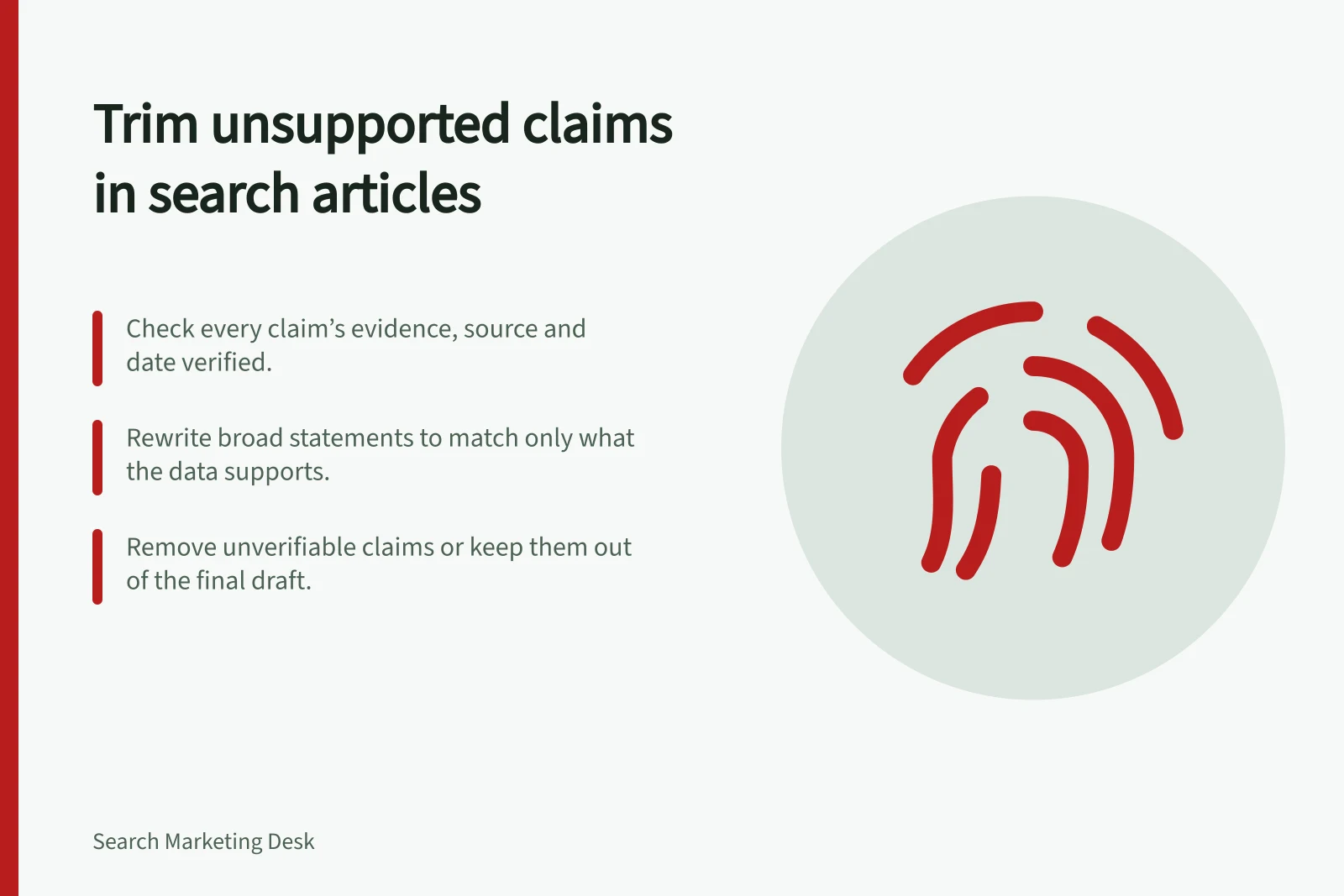
For each material claim, record its exact wording, source or internal record, date checked and any limit imposed by the evidence. The list helps an editor track decisions, but the source still needs to be read.
Test the exact wording
Open the exact primary page or underlying record. Does it support the subject, geography, period, unit and certainty in the sentence?
A source about one product version does not establish a feature across every plan. One customer account does not establish typical results. Check whether a dated source still supports a present-tense claim.
Evidence finding / Edit
- Supports the full claim
- Keep it with any necessary condition.
- Supports a narrower claim
- Rewrite to the supported scope.
- Conflicts with the claim
- Correct the article and check related passages.
- Cannot be verified
- Remove it or keep it out of the publishable draft.
For example, if a source confirms a feature in one named plan, “all customers receive the feature” is too broad. The supported version names the plan and its conditions.
Claim evaluation: what to do based on evidence
- Evidence supports the full claim
- Keep it with any necessary condition.
- Evidence supports a narrower claim
- Rewrite to reflect the supported scope.
- Evidence conflicts with the claim
- Correct the article and check related passages.
- Evidence cannot be verified
- Remove it or keep it out of the publishable draft.
Preserve the useful answer
Removing a sentence may leave a gap. Rebuild the explanation around what can be established.
If a guide recommends the “fastest” option without comparable measurements, replace the ranking with criteria the reader can check: the task, relevant performance measure and conditions for comparison. Do not imply that a comparison was performed.
Separate advice from findings. “Ask the provider to demonstrate the export process” is advice. “The export process takes two minutes” is a measurement claim needing suitable evidence. For a quotation, verify the speaker and exact words or remove it.
Google’s people-first guidance asks creators to consider easily verified factual errors. An accurate limit is more useful than an unsupported promise.
After editing, reread the title, opening, headings, tables, captions and metadata. A removed claim can survive outside its original paragraph. Check that the revised article still answers its main question and keeps each qualification beside the claim it limits.
Key principles for maintaining factual integrity in search content
- Accurate limits are more useful than unsupported promisesGoogle’s people-first guidance prioritises easily verifiable facts.
- Avoid implying unperformed comparisonsReplace rankings without measurements with criteria readers can verify.
- Separate advice from findings‘Ask the provider’ is advice; ‘takes two minutes’ requires evidence.