Content Quality
Part of Search content quality reviews
Deciding whether to update, merge or retire a weak page
Choose a treatment for a weak page from its reader task and content, then plan the old URL’s response.
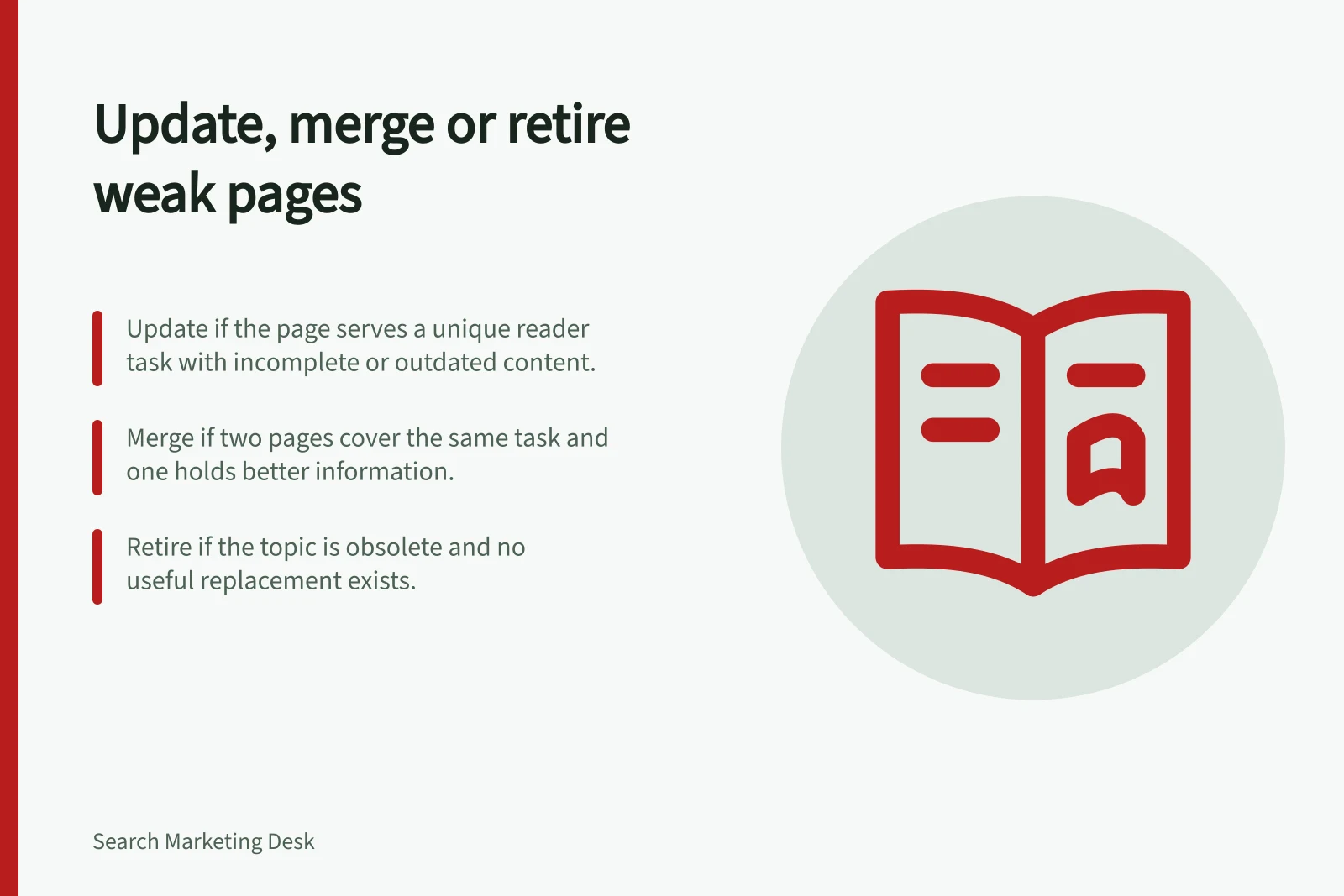
Update a weak page when it still serves a distinct reader task. Merge it when another page covers substantially the same task and can hold its useful material. Retire it when the subject no longer has a useful place on the site and no suitable replacement exists. Decide that before choosing the old URL’s response.
Establish what the page should answer
Record the page’s intended reader, question and next step, then read it alongside its closest current neighbours. A low-traffic page may give a narrow but valuable answer; a high-traffic page may contain inaccurate claims. Search Console can identify pages and queries to inspect.
Check other explanations for weak performance, including technical problems and changing search interest. Google lists several possible causes of traffic drops. A rewrite is warranted when the page’s answer needs one, not simply because a graph fell.
Key factors influencing weak page decisions
- Traffic drop causes (Google)
- Technical issues, content quality, changing search interest
- Redirect strength (Google)
- Treated as a strong canonical signal
- Canonical annotation use
- Expresses preference but Google makes final selection
Choose the content treatment
| Finding | Decision | What to preserve or resolve |
|---|---|---|
| Distinct task; answer is incomplete or outdated | Update | Keep the useful purpose and correct its evidence and limits. |
| Two pages answer substantially the same task for the same reader | Merge | Choose the better home and bring across accurate, unique detail. |
| Subject is obsolete, with no continuing useful answer | Retire | Check whether readers still need a reference or support route. |
| Answer is sound but hard to find | Keep and improve its route | Check navigation and relevant surrounding pages. |
Do not merge merely because two pages share a keyword. Compare their openings, main answers and next actions. One may introduce a topic while another resolves a narrower decision. If the pages really are interchangeable, different titles will not make them useful as separate answers.
Decide what happens to the old URL
A content choice and a URL response are related but separate. If a moved or merged page has a clear replacement that answers substantially the same need, a permanent redirect can take visitors there.
Google treats redirects as a strong canonical signal. A generic homepage redirect usually fails to answer the old visitor’s question.
A retained page may need corrected content at its existing URL. A canonical annotation can express a preference among duplicate or very similar URLs, but Google makes the final selection. Do not use it to treat distinct reader tasks as duplicates.
After implementation, verify the old response, any destination and the paths that lead to the retained answer.
Record and recheck the decision
Keep a short record: old URL, reader task, nearest competing page, material worth preserving, decision, proposed destination or response, owner and date. After release, check the chosen answer and old address. Review later search data in context; a change in clicks is an observation, not proof that the page treatment caused it.