Content Quality
Part of Search result changes and AI features
Keeping AI-search claims separate from documented guidance
Audit AI-search advice against exact provider guidance, dated observations and site evidence before making a content change.
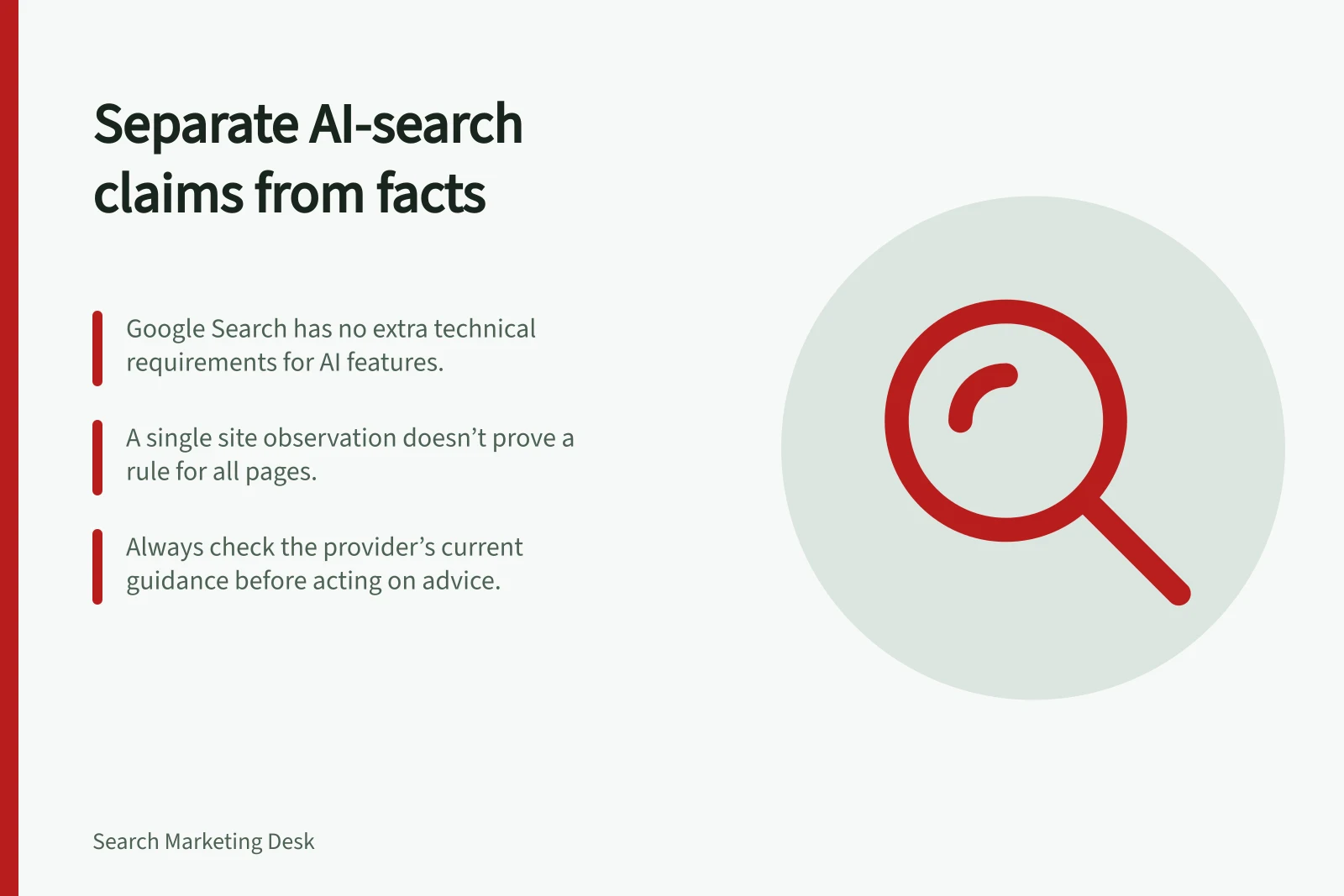
Before using an AI-search claim to guide a website change, identify its provider, feature and evidence. Separate what the provider documents from what someone observed on a particular site, and from an untested tactic. An observation of one result does not establish a rule for every page.
Classify the claim
Consider “Add an AI file to every page to be cited.” That sentence asserts both a requirement and an outcome. Google's guidance says AI features have no additional technical requirements beyond those for Google Search. So the example is not a documented Google Search requirement; this does not establish how every other service works.
| Claim | Evidence to seek | Appropriate conclusion |
|---|---|---|
| Provider behaviour | The provider's current page for the exact feature | State its scope and conditions. |
| Site observation | A dated result or property report | Describe what was seen under those conditions. |
| Proposed tactic | A reader benefit and a measure that could challenge the expectation | Treat it as a choice to assess, not a ranking rule. |
| Outcome promise | Evidence that actually demonstrates the outcome | Remove or narrow the promise if that evidence is absent. |
An eligibility page does not prove that an eligible page will appear. A case study about one site does not promise the same result elsewhere.
Use current Google guidance within its limits
Google says established SEO guidance applies to AI Overviews and AI Mode. A supporting page must be indexed and eligible to appear in Google Search with a snippet.
Meeting these conditions still does not guarantee that Google will crawl, index or show a particular page.
Google Search Console lists a Generative AI performance report (Search). The page title alone does not establish what the report measures or who can access it.
State the provider and surface when repeating this guidance. “Google Search says…” is more accurate than “AI systems require…”. Check the source's date and any setting or geographic limit before applying it to a current decision.
Key Facts About Google Search and AI Features
- No additional technical requirements for AI featuresBeyond standard Google Search requirements
- Indexed and eligible pages may not appear in AI OverviewsCrawling and indexing do not guarantee visibility
- Generative AI performance report available in Search ConsoleAccess may be limited by account or region
- Page title alone does not define report metricsRequires careful interpretation of context
- Use 'Google Search says...' not 'AI systems require...'For accurate attribution
Test the advice implied by a true statement
The format should serve the reader: not every answer needs to be split into tiny blocks. Nor does a clear page guarantee an AI-feature link.
For a proposed edit, trace the reasoning: what does the source say, what would change on the page, how would that help its reader and what observation could challenge the expectation? A clearer explanation of a real eligibility condition may help visitors. “The AI will prefer this format” needs evidence that directly supports that prediction.
Before acting on a claim, open the exact provider page rather than relying on a snippet or second-hand summary. Check the article's title, opening and metadata too: a qualification preserved in the body can be lost in a headline.