Indexation
Part of Search result changes and AI features
Checking whether citations lead to the correct source page
Audit an AI-search link's final URL, source passage and missing qualifications before judging whether it supports a claim.
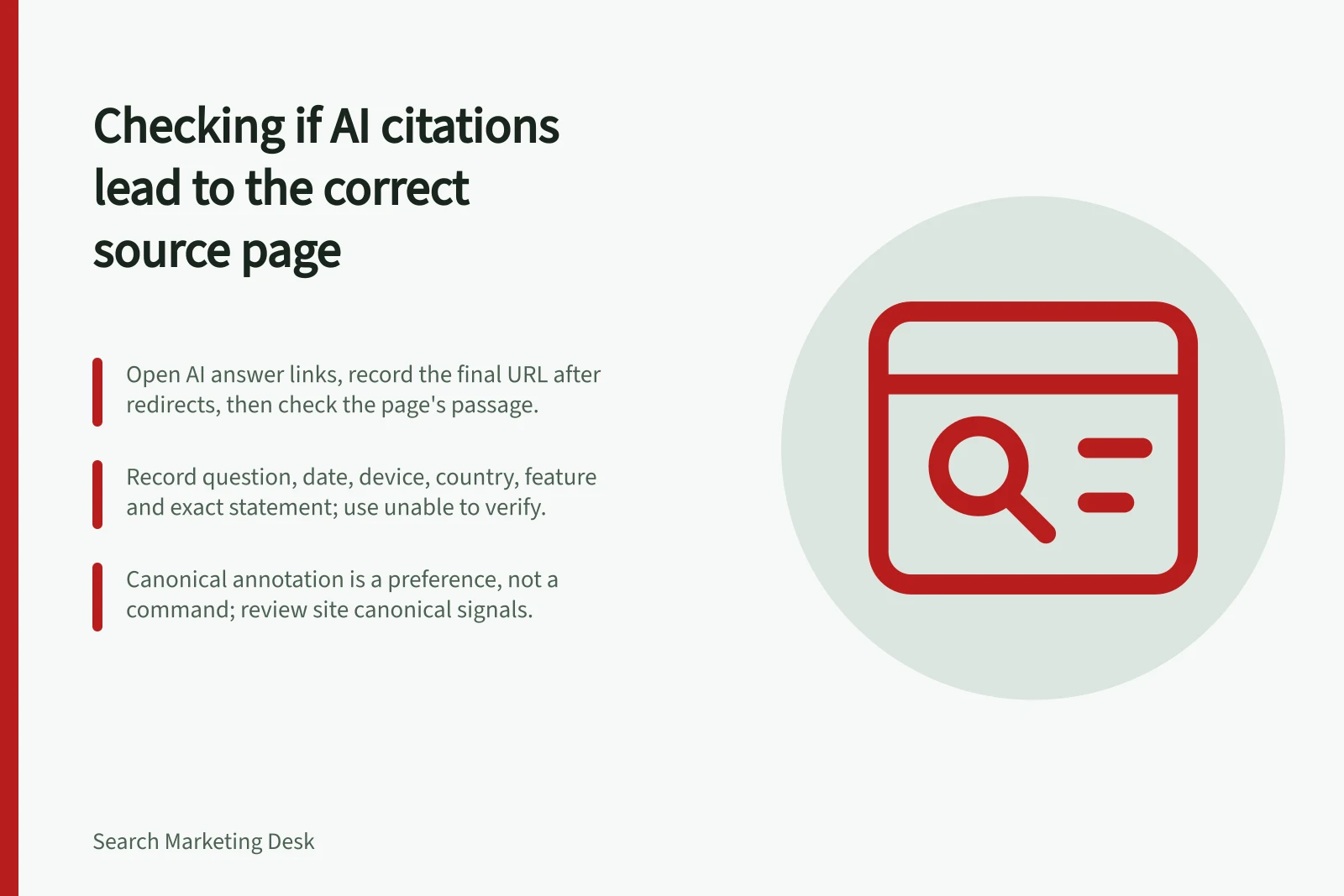
When an AI answer shows a supporting link, open it, record the final destination and check whether that page supports the statement you are assessing. A recognisable domain or relevant title is not enough. Google describes these as links to supporting pages; their placement does not necessarily establish a one-to-one citation for each nearby sentence.
AI Mode and AI Overviews may use different models and methods, so the answers and links they show can differ. A source check describes the result observed under stated conditions, not a permanent list of pages Google will show.
Capture the result and destination
Record the search question, date, device, country setting, feature and exact statement being checked. Note the visible link target where available, open it and record the final URL after redirects. A link labelled as an article can lead to a replacement, broad section, home page or error.
| Check | What to record |
|---|---|
| Destination | Link target, final URL and whether the page loads |
| Page identity | Title, publisher and whether this is the relevant source page |
| Statement support | The passage that addresses the statement being checked |
| Qualification | Date, geography, product version or exception that changes the meaning |
| Finding | Supported on this page, partly supported, wrong destination, unsupported on this page or unable to verify |
Use “unable to verify” if the page cannot be accessed or the necessary passage cannot be checked. Do not declare the statement false solely because one linked page does not support it. Examine other relevant sources before judging the answer itself.
Citation audit record checklist
- Result contextSearch question, date, device, country setting, feature and exact statement
- Visible link targetRecord the link target where available
- Final URLOpen the link and record the final URL after redirects
- Page loadsCheck whether the destination page loads
- Page identityTitle, publisher and whether this is the relevant source page
- Statement supportThe passage that addresses the statement being checked
- QualificationDate, geography, product version or exception that changes the meaning
- FindingSupported on this page, partly supported, wrong destination, unsupported on this page or unable to verify
Check an AI-search citation
- Record the result contextNote the search question, date, device, country setting, feature and exact statement
- Open the supporting linkNote the visible link target where available
- Capture the final URLRecord the destination after redirects
- Identify the pageCheck title, publisher and whether it is the relevant source page
- Read the passage in contextCheck the supporting passage and any qualification that changes the meaning
- Classify the findingUse a narrow finding and keep a short passage or location note
Finding categories for a citation check
- Supported on this page
- The passage addresses the statement being checked
- Partly supported
- The page supports only a narrower or qualified version of the claim
- Wrong destination
- The final page is not the relevant source page
- Unsupported on this page
- The page does not address the statement being checked
- Unable to verify
- The page cannot be accessed or the necessary passage cannot be checked
Read the passage in context
Suppose a result says a service covers all of Australia, while a linked page says selected metropolitan areas. That page supports only the narrower coverage claim. This is a hypothetical example, not a finding about a real provider.
For changing information, check the source's applicable date and whether the passage concerns the current product, version or policy. A general rule may not support a specific price, timing promise or outcome. Keep a short passage or location note with the audit finding so the basis can be checked again.
Diagnose a link to your own site
If a link reaches the wrong page on your site, inspect the old and final URLs. A redirect may send a narrow article to a broad destination that no longer answers the task. For duplicate or near-duplicate URLs, review the site's canonical signals. A canonical annotation is a preference, not a command.
Google says AI feature traffic is included in Search Console's overall web performance data. That data alone does not establish which linked page supported a particular statement.
URL Inspection can help check the HTML Googlebot retrieved while crawling. For the route itself, open the destination and record the final URL.
If your page omits a material condition, correct it for readers. If an AI Overview makes an inaccurate statement despite an accurate source page, record the discrepancy.
Finish with a narrow finding that names the observed result, destination, supporting passage or missing condition, and date.
Diagnose a wrong own-site destination
- Inspect old and final URLsCompare the original link target with the final destination
- Check redirectsSee whether a narrow article is sent to a broad destination that no longer answers the task
- Review canonical signalsFor duplicate or near-duplicate URLs, a canonical annotation is a preference, not a command
- Use URL InspectionCheck the HTML Googlebot retrieved while crawling
- Open the destinationRecord the final URL for the route itself
- Correct material conditionsIf your page omits a material condition, correct it for readers
- Record the discrepancyIf an AI Overview makes an inaccurate statement despite an accurate source page, note it
- Finish with a narrow findingName the observed result, destination, supporting passage or missing condition, and date