Internal Linking
Part of SEO content architecture
Connecting supporting articles to the right main guide
Choose a supporting article's main guide by comparing its reader task, the guide's wider promise and the role of each page.
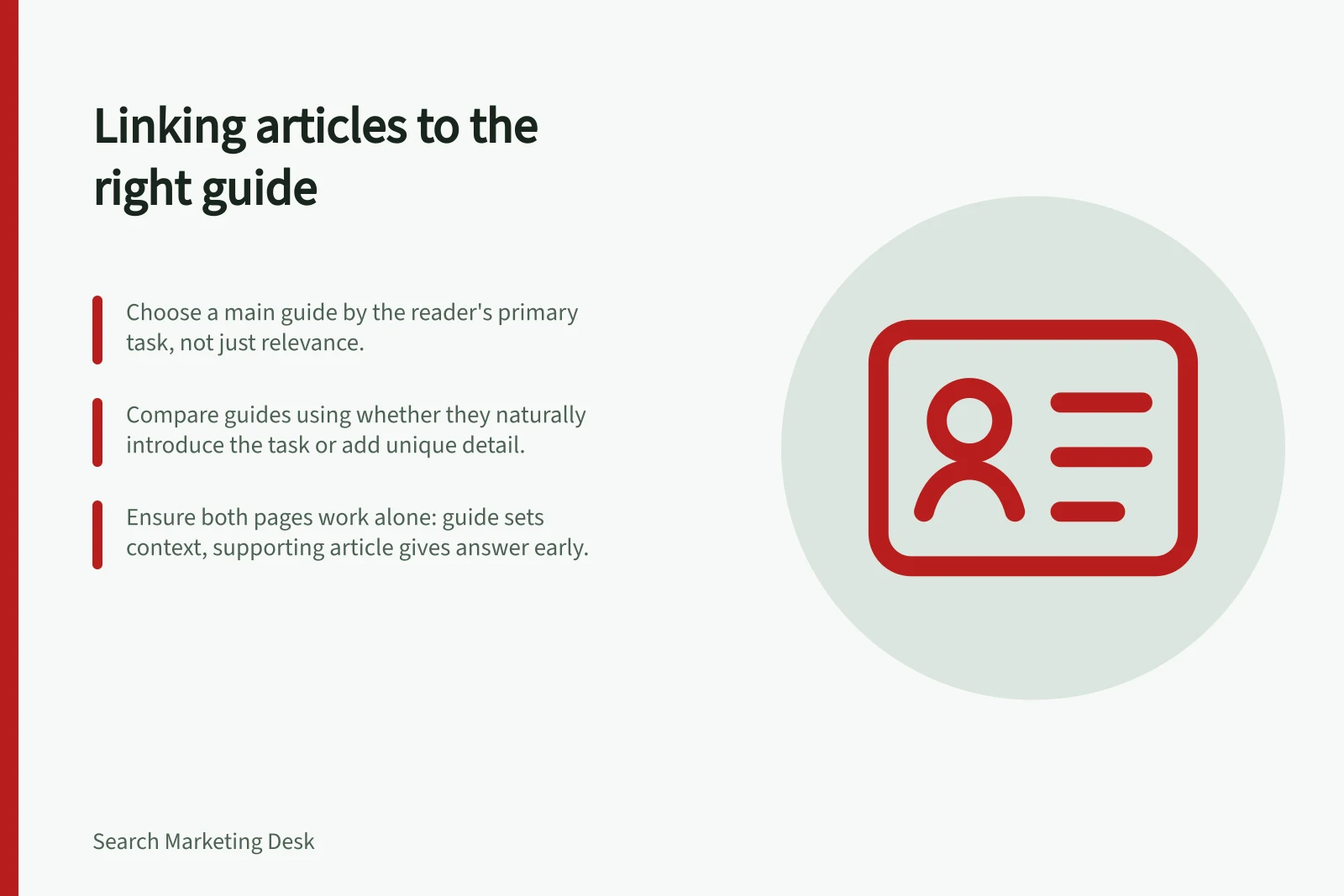
Choose a supporting article's main guide by its primary reader task. The guide gives the wider context for that task; the supporting article supplies the focused answer. A page may be relevant to several guides, but relevance alone does not make each one its editorial parent.
Define the focused answer
Describe the supporting article in one sentence: who needs it, what they must decide or do, and the answer it provides. Ask what wider question a reader might have before or after that task. A guide answering that wider question is a parent candidate.
For example, an article on choosing a main guide for a focused SEO article fits naturally within a guide to content architecture. A guide to internal linking may also refer to it, but its principal task is deciding where an article fits in the content plan, not choosing link wording.
How to assign a supporting article to its main guide
- Define the focused answerDescribe the supporting article in one sentence: who needs it, what they must decide or do, and the answer it provides.
- Identify the wider questionAsk what broader question a reader might have before or after the task.
- Review candidate guidesRead each guide’s opening and main sections—do not rely on titles alone.
- Use decision criteriaApply the comparison table to assess relevance and role alignment.
- Confirm editorial handoffEnsure both pages are useful independently and link logically between them.
Compare plausible guides
Read each candidate guide's opening and main sections. Do not assign a parent from its title alone. Use the focused article's primary decision to break a tie:
| Question | What it reveals |
|---|---|
| Would this guide naturally introduce the task? | Whether readers of the guide are likely to need the focused answer. |
| Does the supporting article add detail rather than repeat the guide's main answer? | Whether the two pages have complementary jobs. |
| Would another guide use the article only for an occasional related point? | Whether that guide is a useful cross-reference rather than the main home. |
One editorial home makes scope and maintenance easier to manage. This is a planning convention, not a Google ranking rule. If no candidate guide introduces the task naturally, reconsider the supporting article's promise or the guide structure.
Pros and cons of assigning multiple guides to one supporting article
- Pros
- Allows cross-referencing across content areas; improves discoverability for diverse user intents.
- Cons
- Creates confusion about primary authority; complicates maintenance and SEO clarity.
Make both pages useful on their own
The main guide should describe the focused task clearly enough for readers to decide whether they need the detailed article. The supporting article should give its answer near the top, so a direct visitor should not need to return to the guide to understand its first steps. It can point to the guide when broader context helps.
Record the intended handoff: which page introduces the task, which page resolves it and why the reader would move between them. When the pages exist on the site, the route should be a relevant, working link.
Google says links are a major way it discovers pages and generally recommends HTML anchors with an href and descriptive text. Those implementation details do not replace the editorial choice of destination.
Key principles for internal linking structure
- Main guide purpose
- Provide context and help readers decide if they need the detailed article.
- Supporting article priority
- Deliver the answer near the top for direct visitors.
- Link implementation
- Use descriptive HTML anchors with `href` attributes for discovery by Google.
Reassess the relationship after major edits
A main guide may later absorb a short supporting answer. A supporting article may grow into a different task. Compare their openings and central answers after a substantial change.
If they now promise the same result, clarify their roles or choose one home for the complete answer. Keep the parent relationship when the guide supplies context and the supporting article still resolves a distinct decision.