Content Quality
Part of SEO content architecture
Organising topic hubs around real reader tasks
Build a topic hub from connected reader tasks, with a clear job for its main guide and each supporting article.
Build a topic hub around a connected set of reader tasks. The main guide explains the wider subject and points readers to the next step. Each supporting article answers a substantial question in its own right. A shared topic word alone does not give a group of pages useful structure.
Trace the reader's work
Write down the starting question and the decisions likely to follow. Someone planning a website's content might first need to understand page roles, then how to group related articles, assign a focused article to a broader guide and handle overlapping answers. That is one possible sequence; readers may enter at any point.
Check each step before making it a page. Does it need a different method, a set of examples or important qualifications? If a short answer fits comfortably within the guide, use a section there.
If a step needs room to be completed, give it a focused page. A phrase variant alone is a weak reason to split a page.
Turn the sequence into page promises
For the proposed hub, write a promise for each page and compare them side by side:
| Page role | Promise | Check |
|---|---|---|
| Main guide | Explain the subject and introduce the major decisions. | Can a new reader understand the whole route? |
| Supporting article | Resolve one decision with enough detail to act. | Does it answer the question for a direct visitor? |
| Neighbouring guide | Cover a different substantial subject. | Is a task being drawn into this hub only because it shares a term? |
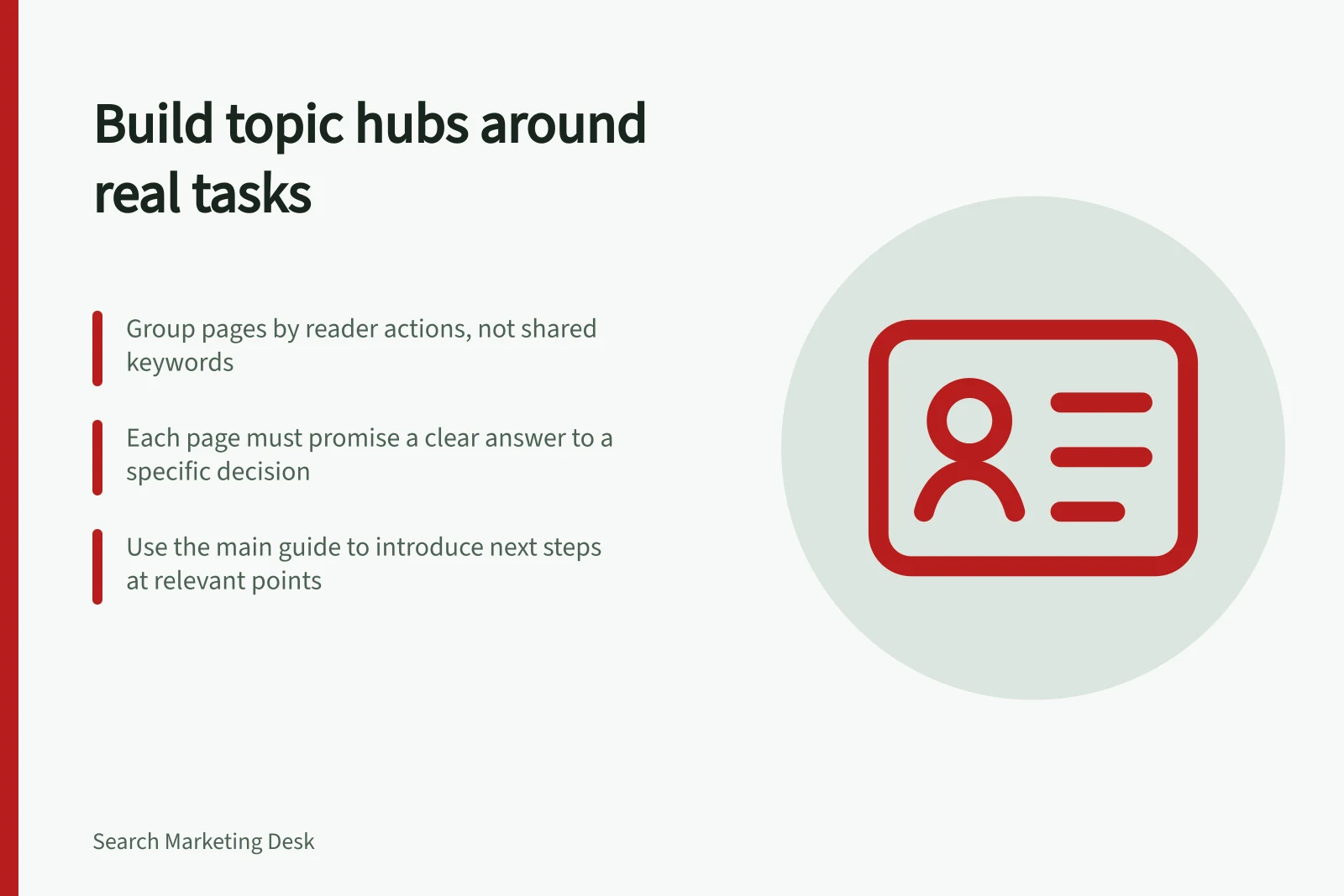
Read the nearest existing pages before accepting the map. If another guide already gives the complete answer, revise the proposed page's job or use the existing answer. Group pages by what readers need to do, not by repeated words in their titles.
Page Roles and Promises in a Topic Hub
- Main GuideExplain the subject and introduce major decisions. Can a new reader understand the whole route?
- Supporting ArticleResolve one decision with enough detail to act. Does it answer the question for a direct visitor?
- Neighbouring GuideCover a different substantial subject. Is a task being drawn into this hub only because it shares a term?
Connect the steps
The main guide should introduce a deeper task at the point where it becomes relevant. A supporting article should start with its answer, then offer wider context when useful. Readers should be able to reach important pages through the site's navigation or relevant content paths, including when they arrive on a page other than the main guide.
Google says links help it find pages. For links it can generally crawl, it recommends HTML anchors with an href and descriptive text. Those are implementation considerations for the eventual site. The hub plan itself should identify which page answers each next question.
Check the hub as a whole
Review the planned route from several starting pages. For each task, identify the page that provides the complete answer and the route a reader would take to reach it. If two pages seem interchangeable, compare their actual answers and adjust the promises. If a supporting page requires the main guide just to make sense of its opening, add the necessary context to the supporting page.
Revisit the map when the subject changes. A new question may fit an existing page, need a focused addition or justify a new article. Each page should still have a distinct reason to be in the hub.