Content Quality
SEO content architecture
Plan SEO content architecture with distinct page roles, useful routes between answers and a practical way to identify overlap.
SEO content architecture gives each important page a clear purpose and a route between related answers. List your pages, the tasks they serve, and any two pages that promise the same answer. Then decide which page gives the overview, which tasks need their own detail, and how readers move between them.
Give each page a job
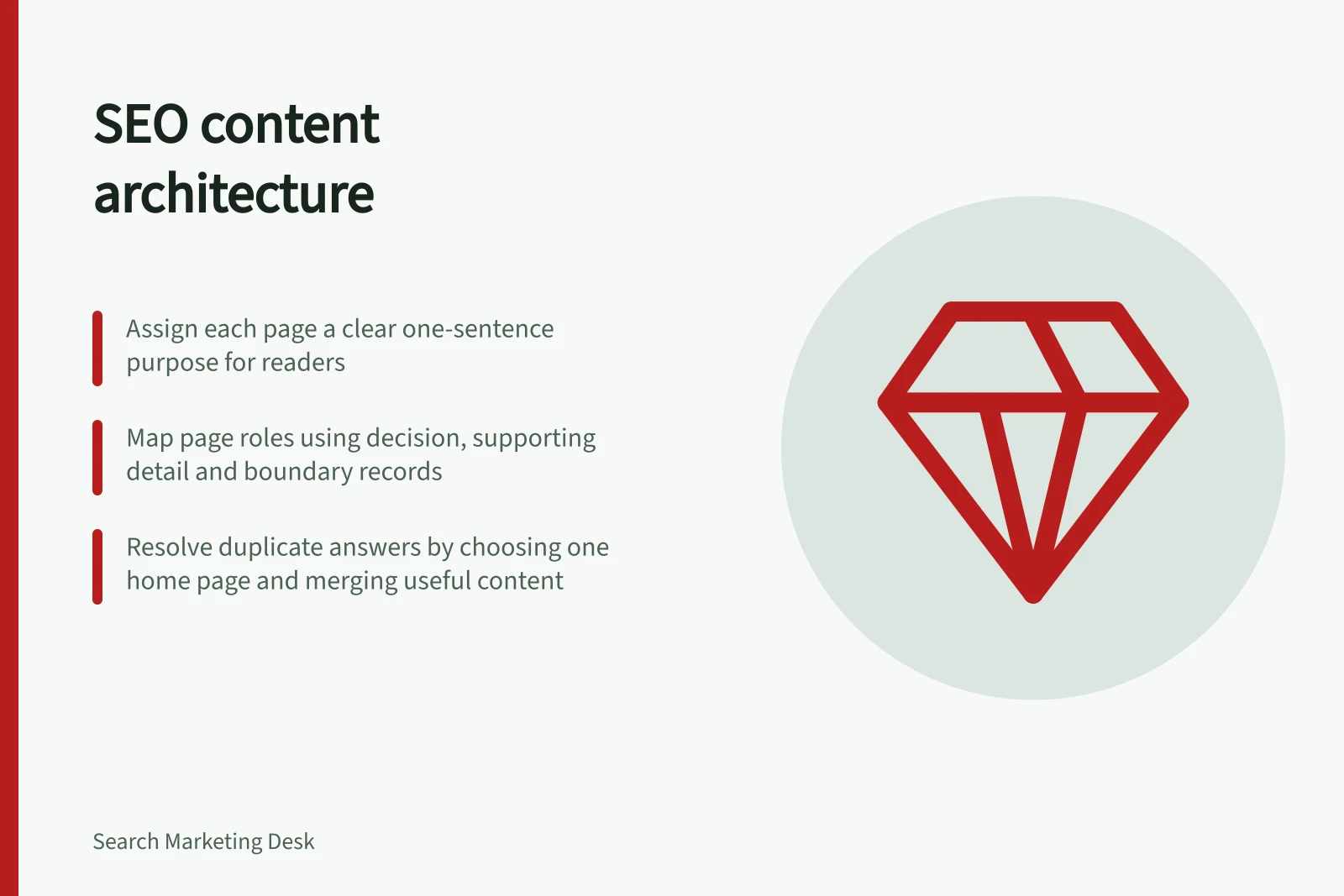
Write a one-sentence promise for every current or proposed page: who it helps, what question it answers and what the reader can do afterwards. A main guide can orient someone to a broad subject. A supporting article can work through one substantial decision. A service page should explain the offer and its limits.
A separate article is useful when a task needs its own steps, examples or qualifications. If the answer is short and fits naturally in the main guide, keep it there. Page count follows the answers readers need; it is not a target.
Page Roles in SEO Content Architecture
- Main GuideOrients readers to a broad subject; provides an overview of key topics.
- Supporting ArticleExplores one substantial decision with steps, examples, or qualifications.
- Service PageExplains an offer and its limits; clearly states what the reader can do next.
Map the pages and their boundaries
Put current URLs, proposed articles and relevant service or product pages in one inventory. Read the closest existing pages; titles alone cannot show whether their answers overlap. For each reader task, record:
| Decision | What to record |
|---|---|
| Main answer | The page that should answer the task and its one-sentence promise. |
| Supporting detail | A distinct question that needs a fuller page, if there is one. |
| Boundary | A nearby topic this page should introduce briefly or leave to another guide. |
This map is an editorial tool, not a required URL pattern. It makes page roles and navigation clearer; it does not mandate a rebuild of an existing site.
Keep neighbouring work separate. Deciding which customer questions deserve content belongs to topic planning. Selecting an individual link and its wording belongs to internal linking. Content architecture concerns how the resulting answers fit together across the site.
Make the route useful
Introduce a deeper task in the main guide where readers encounter it, then offer the focused article when they need more detail. A supporting article should answer its own question for someone who arrives there directly. It can provide a route back to broader context where that helps.
Google describes links as a signal when determining the relevance of pages and as a way of finding new pages to crawl. The editorial decision comes first: which destination actually answers the reader's next question?
Major Google Algorithm Updates Affecting Content Architecture (Australia)
- 2023Helpful Content Update (HCU) — Prioritises content created for people, not search engines; reinforces need for clear page roles.
- 2024Core Web Vitals Integration — Emphasised user experience; supports structured, well-linked content architecture.
- 2025Pages Experience Update — Links content quality and usability; encourages clear navigation between related answers.
Resolve competing answers
Place pages with similar promises side by side. Compare their openings, main sections, intended readers and next actions. If both give the same person substantially the same answer, choose one home for that answer and bring across any useful, accurate material. If their tasks differ, make that difference clear near the top of each page.
Google may group pages whose primary content is the same or very similar and select one as the representative URL. That technical process does not determine whether two articles serve distinct reader tasks, and indicating a canonical preference is a hint rather than a rule. The technical treatment of canonical selection sits with the crawl and index side of the work.
Separate duplicate URLs from overlapping page roles
Similar content can be available at multiple URLs for a range of technical reasons. Some duplicate content on a site is normal, and it is not by itself a violation of Google's spam policies.
Even so, the same content at many URLs can leave readers unsure which page is the right one or whether the pages differ. It can also make it harder to track how the content performs in search results.
Key Facts About Duplicate Content and Canonicalisation
- Google’s stance on duplicate content
- Not automatically a violation of spam policies; some duplication is normal.
- Canonical selection process
- Google may group similar pages and select one representative URL.
- Editorial responsibility
- Content architecture decisions must precede technical canonical tags.
Keep the map current
Review page promises when an offer changes, a guide grows or a new article is proposed. Check whether the overview still describes its supporting pages accurately and whether a new page repeats an existing answer.
Customer questions and enquiries can suggest pages to review. A search report may point you to pages worth reading, but a report alone cannot settle whether two pages repeat one another or should be merged. Read the pages themselves before making that decision.
In this guide
- Organising topic hubs around real reader tasksBuild a topic hub from connected reader tasks, with a clear job for its main guide and each supporting article.
- Connecting supporting articles to the right main guideChoose a supporting article's main guide by comparing its reader task, the guide's wider promise and the role of each page.
- Avoiding several pages that answer the same questionCompare articles by reader task and actual answer, then decide whether to clarify their roles or consolidate useful material.