Content Quality
Part of Organic search strategy for business websites
Choosing search topics from customer needs
Use customer questions, business fit and existing pages to decide which search topics deserve an answer.
Choose a search topic when a customer question matters to the business, the site can answer it accurately and no existing page already does the job. Search volume may offer a clue, but it cannot by itself show whether another page will help someone decide or act.
Why customer questions matter in search content strategy
- Customer-driven topics increase relevance
- Content based on real questions improves user satisfaction and engagement
- Search volume alone is not enough
- High-volume queries may not reflect decision-making intent
- Australian businesses should use local language
- Use terms like 'postcode', 'GST', 'ABN' and 'superannuation' where relevant
Start with the customer's question
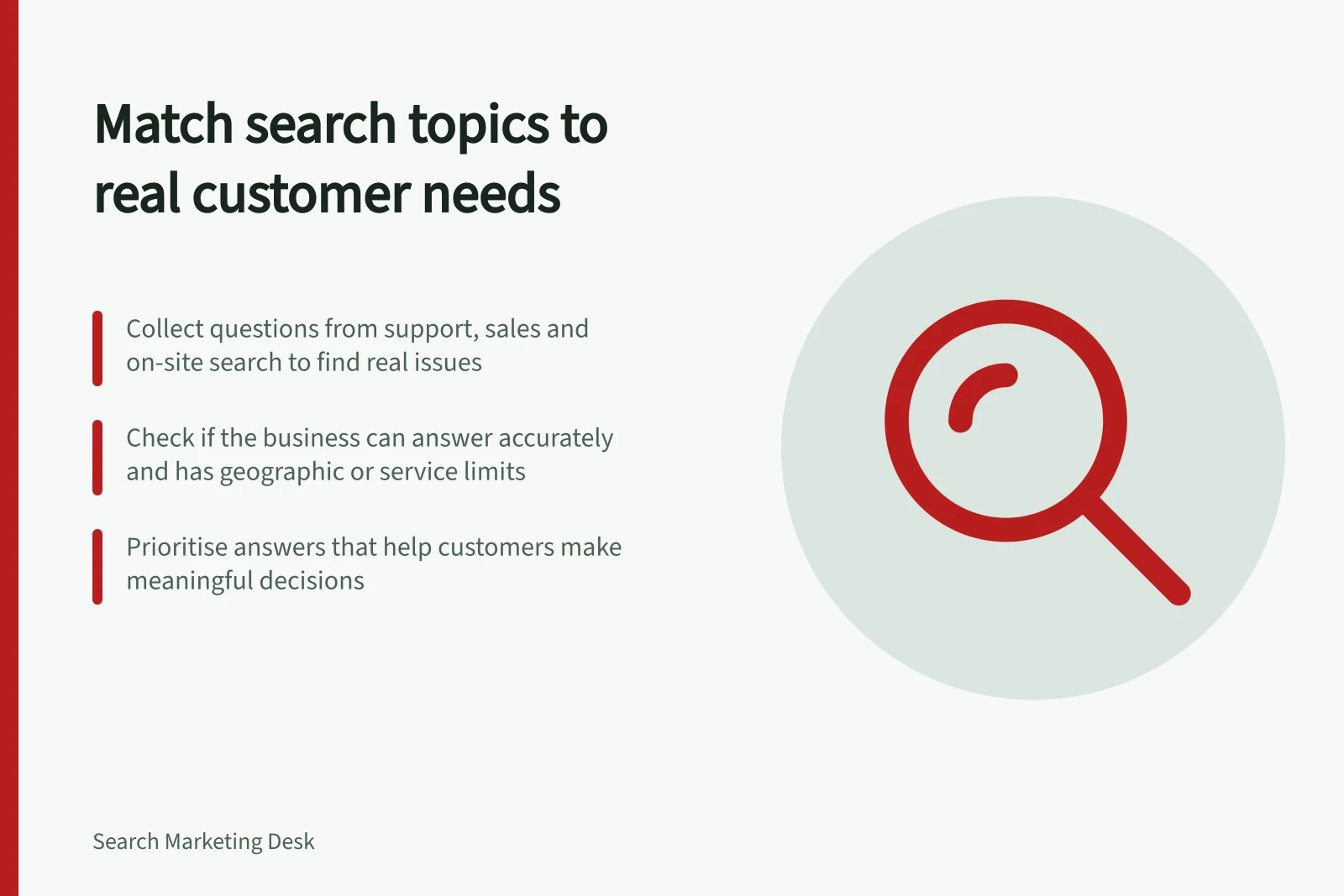
Collect questions from enquiries, sales and support conversations, on-site search and customer feedback. Record the situation behind each question. “Do you deliver?” could concern a particular postcode, delivery timing or the type of item the business will carry.
Search Console adds queries for which the site appeared in Google Search. Read them alongside the pages that appeared instead of treating each query as a separate article idea. Its query tables omit some data, so they provide only a partial view.
Decide what answer the site needs
For each candidate topic, make four decisions:
| Field | Decision |
|---|---|
| Customer task | What must the person understand or decide? |
| Business fit | Can the business help, including any geographic or service limits? |
| Existing answer | Which current page comes closest, and what is missing? |
| Best response | Improve a page, add a focused section or create a distinct page? |
For example, if a repair business often hears questions about collection from regional addresses, its collection page may need a clear coverage section. A general article about repairs would leave that practical question unanswered. The example illustrates a page decision; it does not establish demand for that topic.
Prioritise useful answers
Give priority to questions that affect a meaningful decision, come up in customer interactions and can be answered accurately. Check uncertain signals with people who deal with customers. If the business cannot offer the requested service, explain its limits rather than implying otherwise.
Customers may use different words for the same task. Google advises anticipating those differences and writing naturally, without repeating every possible phrase. Write for the underlying question.
Before drafting, compare the proposed answer with existing pages and planned topics. If two pages would answer the same question for the same reader, improve the existing page or give each page a clearer job. Finish with a named page, the answer it needs to give and the reason it deserves work.