Site Architecture
Organic search strategy for business websites
Plan organic search around customer questions, useful pages, access and business outcomes.
An organic search strategy starts with the customers a business can serve, the questions they ask and the pages that answer them. It checks whether those pages can be found and used, then measures whether visitors take useful steps. A keyword list alone cannot make those decisions.
Pros and Cons of Relying Solely on Keyword Lists
- ProsHelp identify common customer questions; useful for initial content planning
- ConsCannot determine if pages are usable, accessible, or lead to meaningful actions; may miss context like location or intent
Decide what search should help the business do
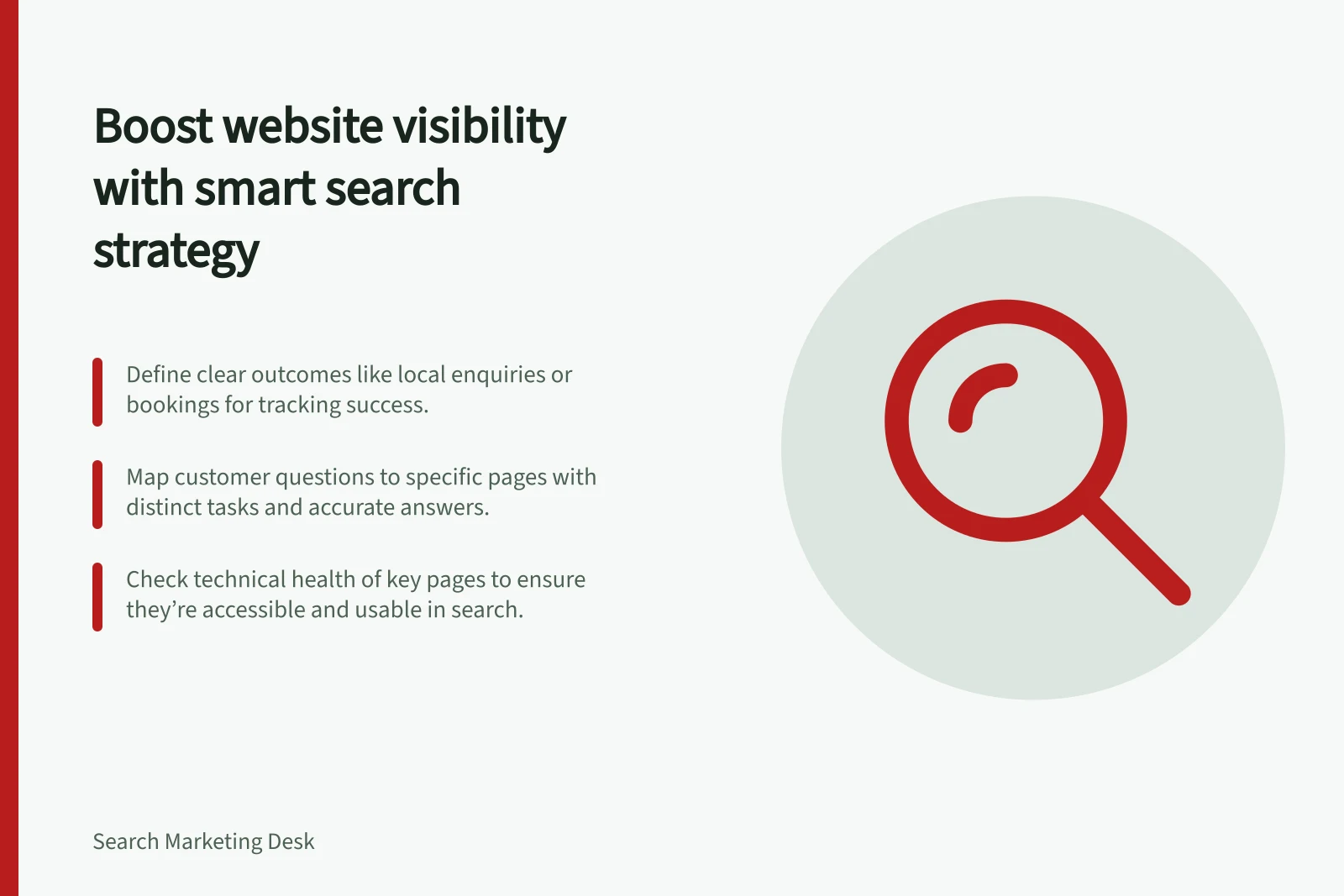
Before planning pages, choose a small set of outcomes: suitable enquiries, bookings, product discovery or another action the business can recognise. Define what makes an action useful. A service business may, for example, value enquiries from its service area more than visits from elsewhere in Australia.
Record the starting position for important pages and actions. Keep measurement definitions consistent when reviewing progress; otherwise a tracking change can look like a change in customer behaviour.
Key Metrics for Measuring Organic Search Success in Australia
- Useful Enquiries from Target AreaTrack leads from local service zones (e.g., Sydney, Brisbane) via form submissions or phone calls
- Search Visibility (Google Search Console)Monitor impressions, clicks, and average position for key pages
- Technical Health ScoreCheck for crawl errors, blocked resources, or duplicate content using Search Console
Match pages to customer tasks
Map the questions customers raise before, during and after a decision. Give each page a distinct job. A service page can explain the offer and its limits; a comparison page can help someone choose; a support page can answer a post-purchase question. Check existing pages before creating another that would serve the same task.
Customer conversations and site search can suggest topics. Choose one when the business can give an accurate, useful answer.
Check whether the pages can do their job
Important pages need a usable route from the site, accessible content and an accurate explanation of their subject. Check them as a visitor and with the search tools available to the business.
Prioritise technical findings by their effect on important pages. An unintentionally blocked service page deserves attention. An intentionally excluded duplicate may need no change.
Google uses automated crawlers to explore the web continually, and the vast majority of sites listed in its results are found and added automatically. A business usually need not take a separate discovery action simply because it has published a page.
Use search guidance as a baseline, not a formula
Use relevant Search Essentials practices to help search engines crawl, index and understand the site. Not every suggestion will apply to every business.
Treat guidance as a basis for sound decisions, not a promise of a particular ranking. Google notes there are no secret changes that automatically put a site first.
Allocate work between search channels
Organic work improves website pages and their unpaid search presence. Paid search involves campaigns, budgets, ads, bidding settings and landing pages. Both can address the same customer need, but they require separate planning.
A paid campaign may suit a defined offer when the business has a budget and a way to assess results. Website pages still need clear, accurate answers, whether visitors arrive through ads or unpaid results. Assign owners to both channels and compare what each reveals about customer questions, without treating their reports as interchangeable.
Organic vs Paid Search: Roles and Responsibilities
- Organic Search Focus
- Improving website pages for unpaid visibility; ensuring accurate, helpful content
- Paid Search Focus
- Running campaigns with budgets, ad copy, bidding, and landing page optimisation
- Shared Requirement
- Clear, accurate answers regardless of how visitors arrive (organic or paid)
- Ownership
- Assign separate owners to each channel to track insights without mixing reports
Run a manageable review cycle
For each priority page, record its customer task, current obstacle, proposed change, owner and review date. Start with consequential changes, such as clarifying an offer, correcting a misleading page or making a useful page easier to reach.
Review Google Search visibility alongside useful business actions. Search Console reports activity in Google Search; site analytics or business records are needed to assess what happened after arrival.
A movement in search data alone does not prove that the latest edit caused it. Revisit priorities as the offer, customer questions and website change.
Set a review interval that gives changes time to be assessed. Continue to watch for issues that affect important pages.
Key Steps in an Organic Search Strategy for Australian Businesses
- Identify priority pages and their customer tasksMap customer questions to specific page functions (e.g., service explanation, product comparison)
- Record current obstacles and proposed changesDocument issues like unclear offers or poor navigation; assign owners and review dates
- Implement changes with focus on high-impact updatesPrioritise fixes such as clarifying service areas or correcting misleading content
- Review performance over timeAssess Google Search Console data alongside business actions (e.g., enquiries, bookings)
- Revisit priorities as needs evolveAdjust strategy based on updated offers, customer questions or website changes
Allow time for changes to take effect
Search changes may take a few hours to several months to be reflected in Google's results. Google generally suggests waiting a few weeks before assessing whether work has helped, rather than judging a change immediately.
Not every website change produces a noticeable effect in search results. If results are unsatisfactory and the business's strategy allows, make further changes and assess them over time.
In this guide
- Choosing search topics from customer needsUse customer questions, business fit and existing pages to decide which search topics deserve an answer.
- Organic search versus paid search: separating the workClarify the different jobs, controls and reports for organic and paid search before allocating work.
- Defining SEO outcomes beyond keyword positionsDefine SEO success through relevant visibility, useful site actions and business quality, with positions as context.