Site Architecture
Local organic search
Plan local organic search around real service coverage, useful pages, accurate business details and carefully interpreted visibility data.
Local organic search connects people with a business that can serve a particular place. Define the real offer and service coverage first, then state both clearly on useful website pages.
A business may also keep a Google Business Profile. Adding a place name to a page cannot make an unavailable service local.
Separate the website from the Business Profile
A website page can explain a service, who it suits, where it is available and how to enquire. Keep website pages and a Business Profile distinct within the business’s online presence. Do not treat profile activity as a website visit, or assume a website click became an enquiry.
For a business customers visit, publish the address and hours of the actual customer-facing location. For a business that visits customers, explain where it can travel and any practical limits. Keep profile settings and published coverage aligned with the operating model and actual coverage.
What to publish: customers visit you vs you visit customers
- Business customers visit
- Publish the address and hours of the actual customer-facing location.
- Business visits customers
- Explain where it can travel and any practical limits.
Give each page a clear customer task
A core service page should answer what is provided, where it can be delivered, any important conditions and the next step. Keep qualifications beside the offer.
Add location detail when it changes that answer: a premises customers can visit, different hours, a limited delivery area, or a service offered in one region but not another.
A separate location page is useful when it helps someone choose or reach a real location. A service-area page needs information that a shared service page cannot explain clearly. Pages that merely swap city names give readers little reason to use them.
Google lists city-targeted pages that funnel people to one destination among its doorway-abuse examples. That does not make every city page a doorway.
Core service page: the questions it must answer
- What is provided
- Where it can be delivered
- Any important conditions
- The next step
- Qualifications kept beside the offer
Keep page content truthful
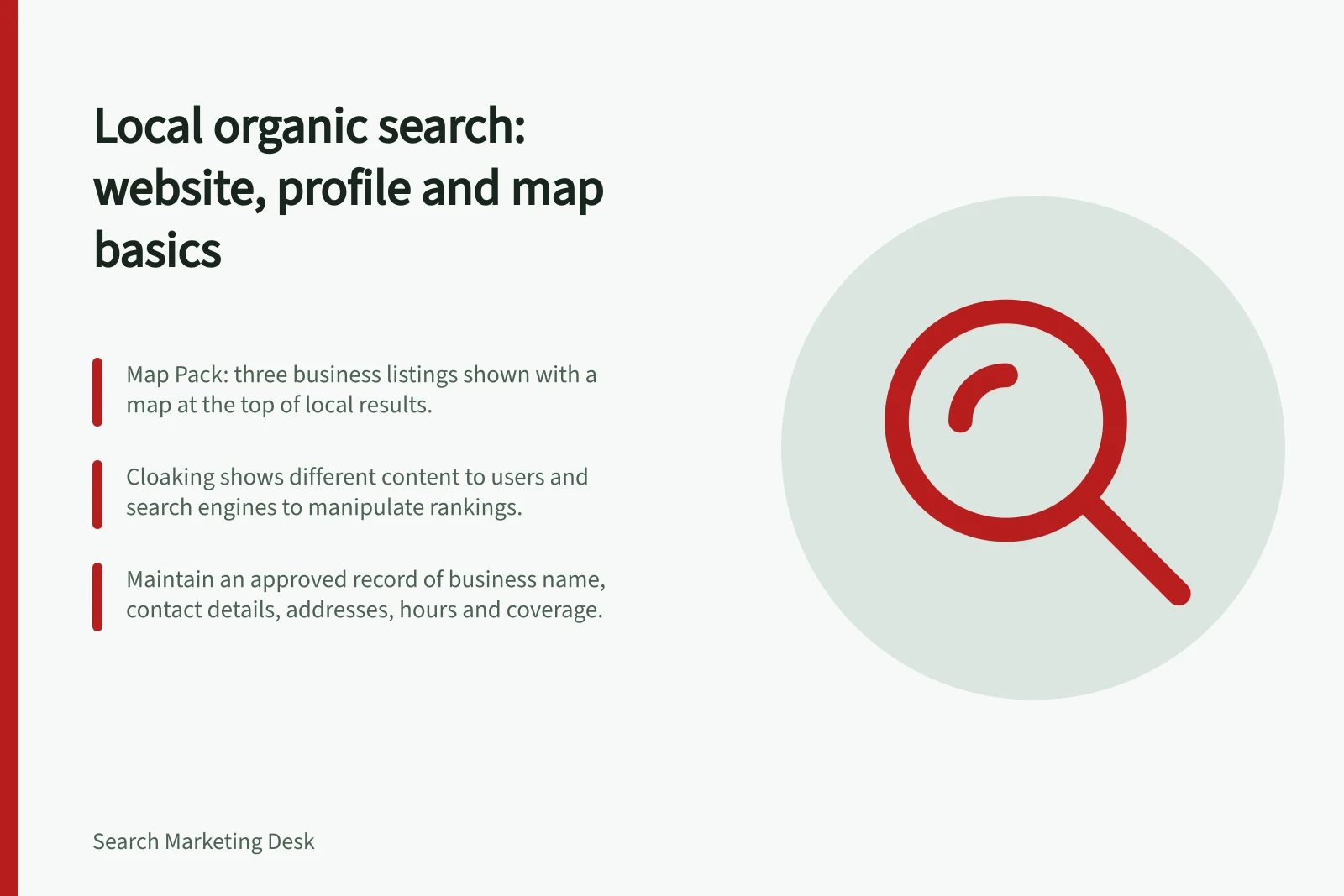
Google defines cloaking as presenting different content to users and search engines with intent to manipulate rankings and mislead users. One example is showing search engines a page about one subject while showing users a page about another.
Google’s spam policies apply to web search results, including results from Google’s own properties. Google says it uses automated systems and, when needed, human review to detect violations; sites may rank lower or not appear at all.
Keep the facts aligned
Maintain an approved record of business name, contact details, customer-facing addresses, hours and coverage. Check the homepage, contact page, service pages, location pages and templates that repeat those details. Update the Business Profile separately where one is used. When a location closes or a service boundary changes, correct the affected claims.
Consistency does not require identical sentences everywhere. A contact page may give directions while a service page explains where staff travel. Both should agree on the underlying facts. Do not invite customers to visit an address where they cannot be served.
Google says businesses with complete and accurate information are more likely to show up in local search results.
Facts to keep aligned, and where to check them
- Recordbusiness name
- Recordcontact details
- Recordcustomer-facing addresses
- Recordhours
- Recordservice coverage
- Checkhomepage
- Checkcontact page
- Checkservice pages
- Checklocation pages
- Checktemplates that repeat those details
Judge visibility against the intended area
Review queries and pages in Search Console, using available reporting dimensions where useful. Treat geographic reporting cautiously: it cannot establish that a searcher was near a shop or inside a service boundary. Location reporting in GA4 does not, by itself, prove residence or eligibility for service.
If reviewing a Business Profile, record its activity separately from website actions. Treat reported interactions as indicators, not confirmed sales or visits. Avoid labelling activity organic unless its source is known.
Ask whether a relevant page appeared for a need the business could fulfil, and whether the visitor took a meaningful next step. Record the page, intended area, period and action. Treat later movement as a reason to investigate, not proof that one edit caused it.
Reviewing local visibility: a cautious sequence
- Review queries and pages in Search Console, using available reporting dimensions where useful.
- Treat geographic reporting cautiouslyit cannot establish that a searcher was near a shop or inside a service boundary.
- Record Business Profile activity separately from website actions.
- Treat reported interactions as indicators, not confirmed sales or visits, and do not label activity organic unless its source is known.
- Ask whether a relevant page appeared for a need the business could fulfil, and whether the visitor took a meaningful next step.
- Record the page, intended area, period and action.
- Treat later movement as a reason to investigate, not proof that one edit caused it.
Recognise the map result as a separate surface
The Map Pack, also called the Local Pack or 3-Pack, is three business listings shown with a map at the top of local search results. It is distinct from the website’s organic result. Record which surface you are reviewing when assessing visibility.
Two separate surfaces to record
- Map Pack (Local Pack / 3-Pack)Three business listings shown with a map at the top of local search results.
- Website organic resultA distinct surface; record which one you are reviewing when assessing visibility.
In this guide
- Matching service pages to actual service coverageMap each service to real coverage, choose useful pages and make booking conditions clear before a customer enquires.
- Keeping business details consistent across the websiteCreate a source of truth for business details and find conflicting addresses, hours, contact numbers and coverage claims across your site.
- Avoiding near-identical city pages with no local valueDecide which city pages deserve to exist, which information belongs on a main service page and how to review pages that differ only by place name.
- Evaluating local search visibility without assuming every visitor is localUse Search Console, GA4 and Business Profile data without treating every visitor or interaction as a local customer.