Indexation
Part of Local organic search
Keeping business details consistent across the website
Create a source of truth for business details and find conflicting addresses, hours, contact numbers and coverage claims across your site.
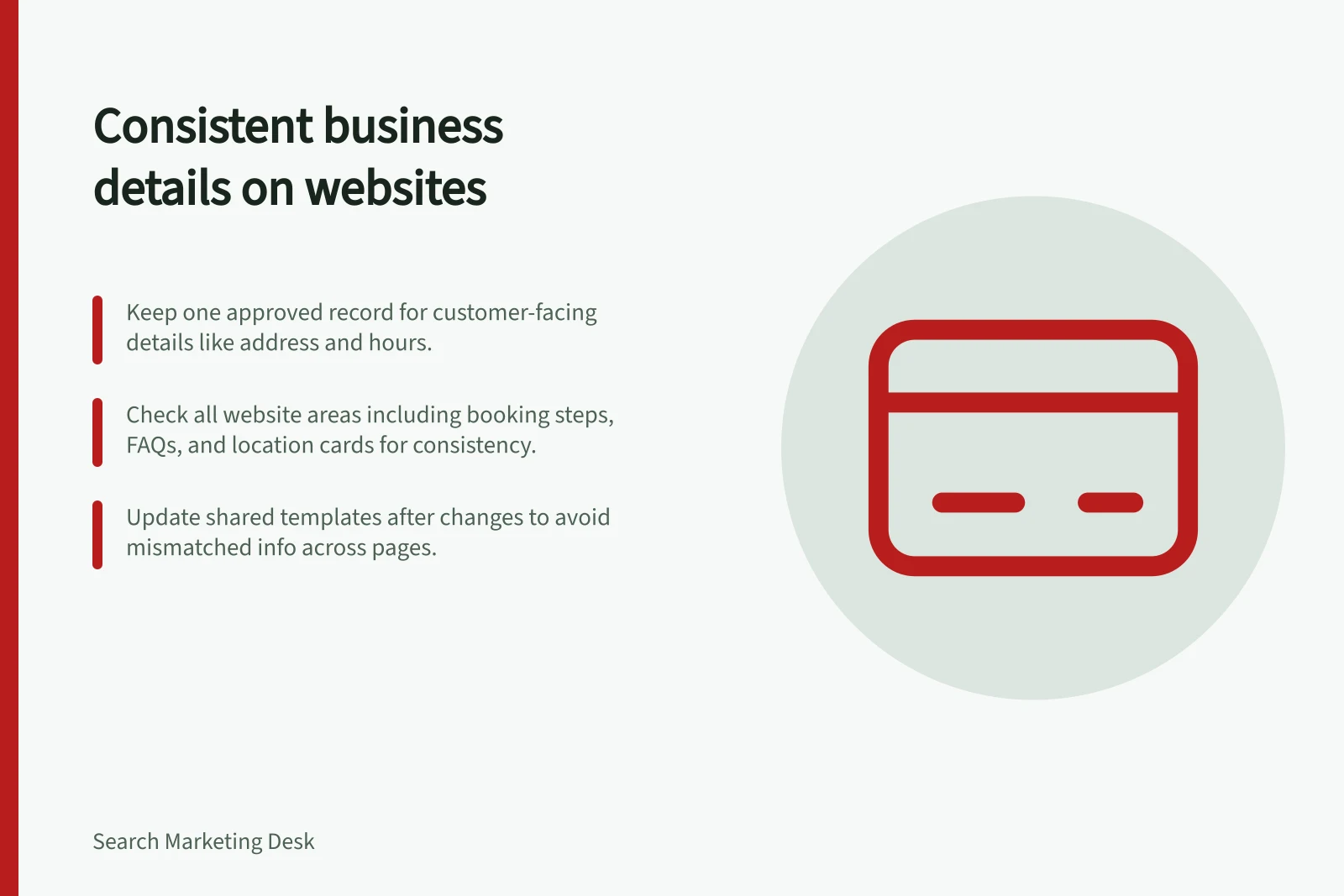
Keep one approved record of the details customers need, then check every website location where those details appear. The aim is agreement about the real business, not identical wording. A contact page, service page and footer may explain different things, but they should not give conflicting addresses, hours, phone numbers or service boundaries.
Decide which facts are authoritative
Give each business location its own record: customer-facing name, address if customers can visit, contact number, regular and exceptional hours, and services or areas that differ from other locations. Assign someone who can confirm changes. Record when each detail was last confirmed so an old footer does not silently become the source of truth.
Keep premises and service areas distinct in your records. A business may serve customers at a premises, travel to customers, or do both. Describe accurately which applies, and avoid inviting customers to visit a place where they cannot be served.
Trace where a change must go
Check the homepage, header and footer, contact page, location pages, booking steps, service pages, FAQs and generated location cards. Search for old and new forms of an address or phone number. A visible page may be correct while a booking confirmation still repeats obsolete hours.
| Change | Places to review |
|---|---|
| New opening hours | Contact and location pages, footer, booking journey and Business Profile. |
| Moved premises | Directions, map references, customer-facing address and pages promising a visit. |
| New phone number | Tap-to-call controls, forms, templates and location-specific contact blocks. |
| Reduced service area | Service claims, area pages, booking eligibility and Business Profile service area. |
If the website uses LocalBusiness structured data, compare its business details with the visible page. Markup can describe details such as hours and telephone, but it does not replace accurate information for customers.
Resolve differences by customer task
Not every variation is an error. A service page might state that staff travel to selected postcodes while the contact page gives the workshop address. Both can be useful if they describe separate ways to use the business.
A conflict is a detail that would lead a customer to the wrong action.
Confirm the operational fact before editing. Where possible, update the shared template or data field, then inspect representative rendered pages. If locations have different hours, a single company-wide time in every footer would create a new mismatch.
Repeat the check after a move, schedule change, new location or service change. A short change log with the owner, affected fields and pages reviewed makes the next update easier. Track external listings separately from the website audit.