Site Architecture
International and multilingual SEO
Plan language and regional pages around real reader needs, then align URLs, hreflang, local content and canonical signals.
International SEO starts with the readers a business can serve and the answer each group needs. Some need another language; others need different regional details in the same language. Decide which pages are useful before choosing URLs or search annotations.
Distinguish language from market
A multilingual site offers content in more than one language; a multi-regional site explicitly targets users in different countries. Google Search tries to match a page to the searcher’s language in the first case, and to the right locale in the second.
These plans can overlap. A Canadian business might offer English and French, while a manufacturer shipping to Canada and the United States may target both markets. A site can therefore need both language and country distinctions, rather than treating every market as a separate translation.
Google may find alternate-language pages without explicit labels, but says it is generally better to identify pages for particular languages or regions explicitly.
Decide which versions need a page
For each intended market, confirm the language readers need and the offer they can use. Availability, delivery, currency, support or terms may change the answer. Australian and UK English pages, for example, may need different practical details even when they describe the same service.
A country appearing in a search report is not, by itself, a reason to create a page. If one page answers the task accurately across several markets, another regional version may add little. Where a local condition changes the answer, explain it on the relevant page.
Give each version a stable address
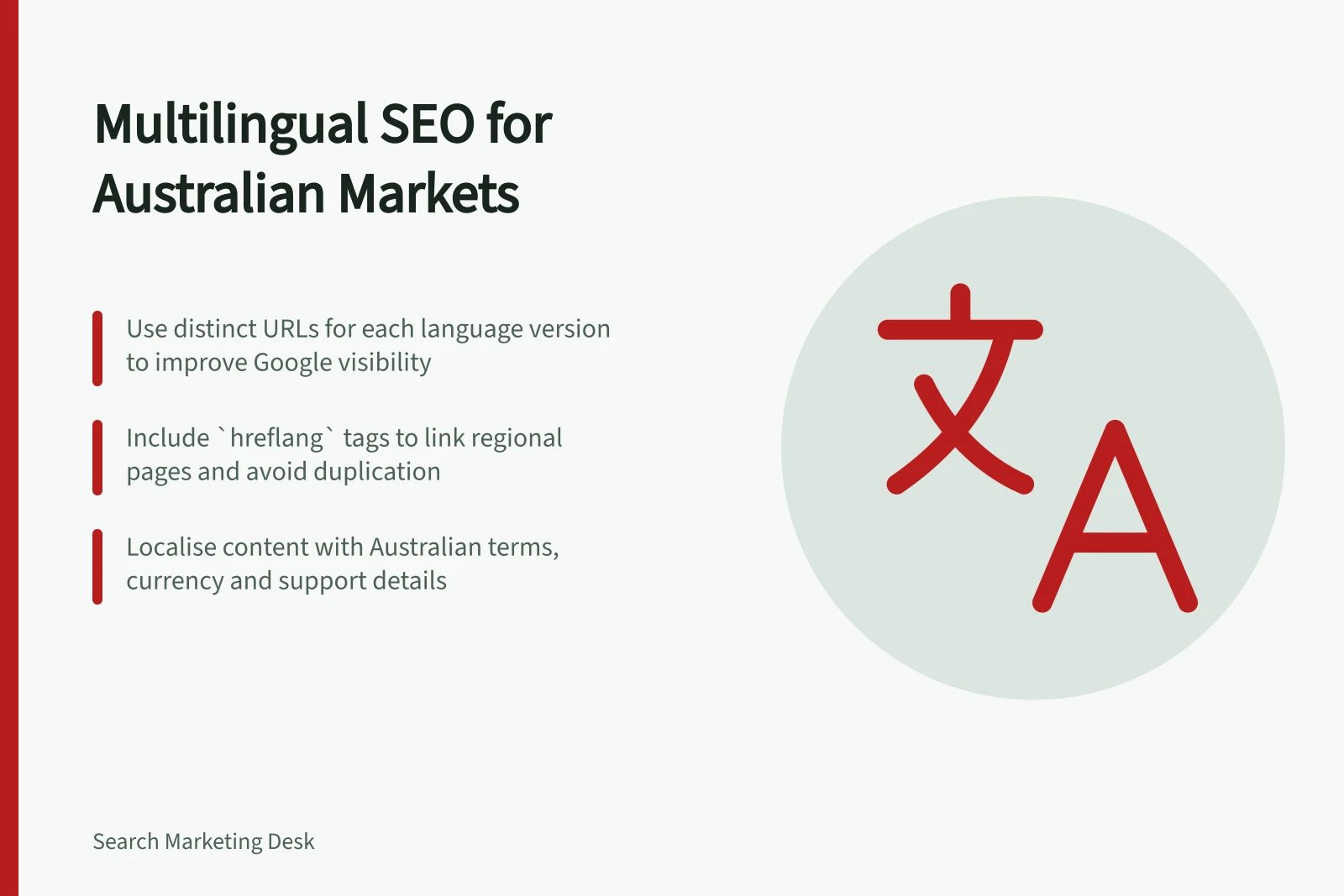
Google recommends a separate URL for each language version, instead of changing the language at one URL according to cookies or browser settings. A distinct address lets readers open and share the version they chose. Offer a visible language or region switcher, and avoid redirecting people away from a version they deliberately opened.
Country domains, subdomains and subdirectories are possible structures. Choose a pattern the team can maintain across content, navigation and technical settings. A locale label in the address does not, by itself, tell Google the page’s language.
Changing content or redirecting people according to language settings can also make some versions harder for Google to find and crawl. Googlebot usually comes from the United States and does not set an Accept-Language request header, so it may not encounter every variation through those signals alone.
Pros and Cons of Different URL Structures
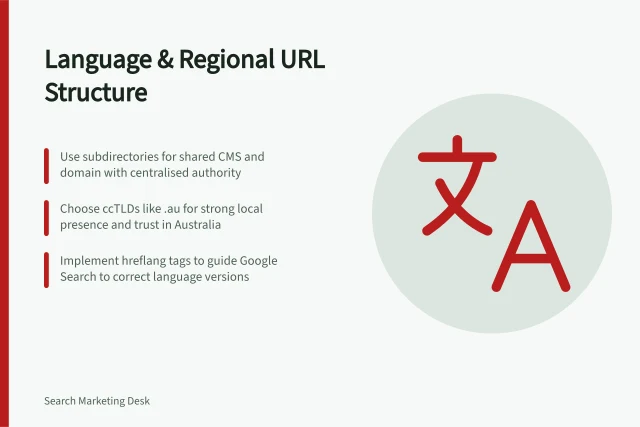
- Country Domain (.au, .ca, .uk)Pros: Clear regional targeting; strong for local trust. Cons: Harder to manage and scale; requires separate registration per country.
- Subdomain (en.au.example.com)Pros: Easy to segment content; good for large international sites. Cons: Can be harder to manage technical setup and canonical signals.
- Subdirectory (/en-au/, /fr-ca/)Pros: Simple to maintain; centralised site authority. Cons: May require careful handling of canonicalisation and hreflang logic.
Connect corresponding pages
hreflang helps Google understand which URLs are language or regional versions of a page. Map them by page purpose: a service page should lead to corresponding service pages, not to another market’s home page because a counterpart is missing. Local details can differ while the central reader task remains the same.
Google supports hreflang in HTML, HTTP headers and XML sitemaps. Choose a method the site can keep accurate. Each version should include itself and its alternatives, with reciprocal annotations between corresponding pages.
When several pages serve the same language in different regions, consider whether readers outside those regions need a general-language option. Google’s example is to offer a general English page alongside pages for English speakers in Ireland, Canada and Australia; the general page can be one of those regional pages if appropriate.
Make the local answer accurate
Translate the main answer, not just the navigation. Review examples, units, currency, contact routes and conditions that affect a decision. A fluent translation is still misleading if it promises a product or service unavailable to its readers.
Google determines page language from visible content, not from the URL label or HTML language attribute. Keep the main content and navigation understandable in the intended language, and provide a clear next step that applies to that market.
Avoid putting translations side by side on one page, and do not translate only secondary text while leaving the main content in another language. Google uses visible content to determine language, so a page with mostly untranslated material may create a poor experience when similar results appear with different translated boilerplate.
Local wording can change what a page means to its audience. For example, “thongs” refers to footwear in Australia but to female underwear in the United States, so terminology should suit the readers the page is intended to serve.
Key SEO Best Practices for Multilingual Sites
- Translate main content, not just navigationEnsure key service descriptions, pricing, and offers are fully localised.
- Use local units and currencyDisplay prices in AUD, include GST, and use metric units for Australian audiences.
- Avoid ambiguous terminologyUse ‘thongs’ for footwear in Australia; avoid confusion with US usage (underwear).
- Google uses visible content to detect languageHTML language attribute alone is not sufficient—content must be readable in the target language.
Check canonical signals separately
Canonical signals express a preferred representative among duplicate or very similar URLs; hreflang identifies locale alternatives. A fully translated main page is not automatically a duplicate of its source page. Similar regional pages in one language need closer review because Google may select a representative URL different from the site’s preference.
Compare important page pairs, redirects, canonical annotations and alternate targets. Start with a manageable set of pages whose local answers can be confirmed and maintained, then revisit them when the offer changes.
Google considers signals including protocol, redirects, sitemap URLs and canonical annotations when selecting a representative. A canonical preference is a hint, not a rule. For same-language regional versions, Google recommends considering canonical signals together with hreflang.
In this guide
- Choosing a language and regional URL structureCompare country domains, subdomains and directories for multilingual pages, then check the maintenance and reader implications.
- Using hreflang only for genuine equivalent pagesDecide which local pages belong in an hreflang group and check reciprocal annotations without pairing unrelated destinations.
- Keeping translated pages useful for their local readersReview translated pages for accurate local offers, natural language, relevant examples and a working next step.
- Checking canonical signals across language variantsCheck canonical preferences and Google’s selected URLs across translated and same-language regional pages without confusing them with hreflang.