Site Architecture
Part of Organic search strategy for business websites
Organic search versus paid search: separating the work
Clarify the different jobs, controls and reports for organic and paid search before allocating work.
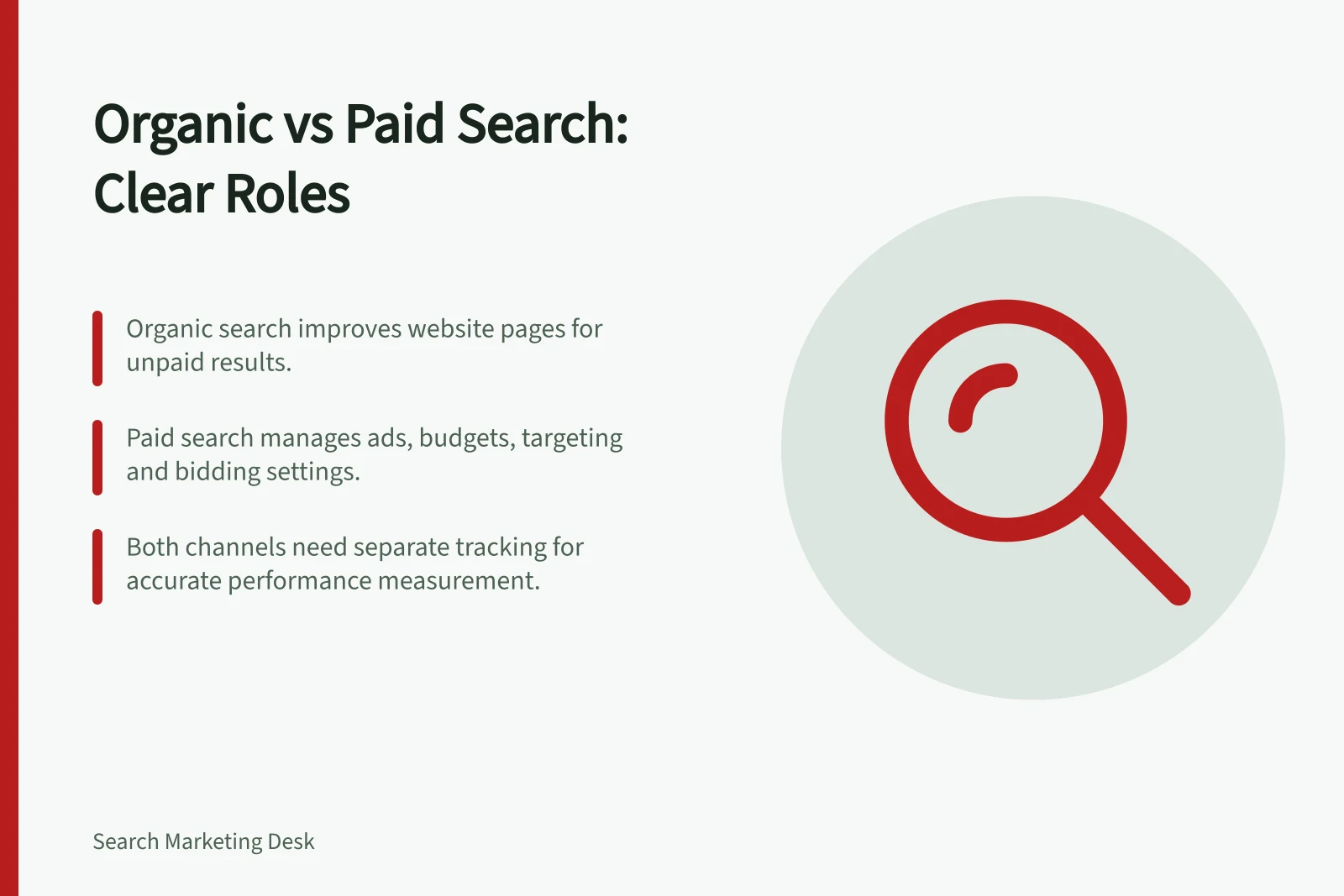
Separate organic and paid search by the decisions each team controls. Organic work improves website pages for unpaid results. Paid search manages campaigns, ads, budgets, targeting, bidding settings and landing pages. Both can serve the same customer need, but buying Google Ads does not raise a page's organic position.
Give each channel a defined job
| Decision | Organic search work | Paid search work |
|---|---|---|
| Main asset | Useful, accessible website pages | Campaigns, ads and suitable landing pages |
| Visibility control | Improve pages and access; appearance is not guaranteed | Set campaign eligibility and budgets; an ad's appearance still depends on an auction |
| Early signals | Page visibility and Google Search clicks | Ad delivery, spend and tracked campaign actions, if configured |
| Ongoing responsibility | Keep answers and offers accurate | Monitor settings, spend and results |
The table describes responsibilities, not promised outcomes. A running ad campaign does not ensure an ad appears in every auction. Organic changes can also take time to appear in Google Search.
Match the work to the problem
If customers cannot tell whether a service suits them, clarify the page. The same explanation matters whether they arrive through an ad or an unpaid result.
If a time-limited offer needs exposure to a defined audience, and the business can fund and assess a campaign, paid search may be suitable. Its landing page must still explain the offer accurately.
If a page receives relevant search impressions but few clicks, inspect the queries and what the page promises before changing it. If a campaign attracts clicks but few suitable enquiries, inspect its search terms, ad promise, landing page and enquiry process. Neither diagnosis follows from a single metric.
Share learning while keeping the measures clear
Paid search terms can suggest questions to investigate in customer conversations and site content. Organic query and page data can suggest subjects for a campaign. Treat both as leads to check, not proof that a change will work in the other channel.
Keep ad spend and campaign actions in the paid report. Search Console shows Google Search visibility and clicks, not completed sales. Site analytics can help assess actions after arrival when the relevant tracking and traffic-channel definitions are configured. Agree on owners for the website, campaign and measurement setup so that each finding leads to a clear next decision.
Key measurement sources for organic and paid search
- Paid search metrics
- Ad spend, campaign actions, delivery, spend and tracked campaign actions
- Organic search metrics
- Google Search visibility and clicks (via Search Console)
- Post-arrival actions
- Site analytics with proper tracking and traffic-channel definitions