Content Quality
Part of Measuring organic search performance
Comparing branded and non-branded Google Search activity
Compare branded and non-branded Google Search activity while accounting for filter availability, classification errors and missing query data.
Separate queries containing the business’s name from broader searches for what it offers to see which group accounts for a change. In Search Console’s Performance report (Search results), compare the groups under the same reporting settings; the split describes query patterns, not their cause.
Define the groups
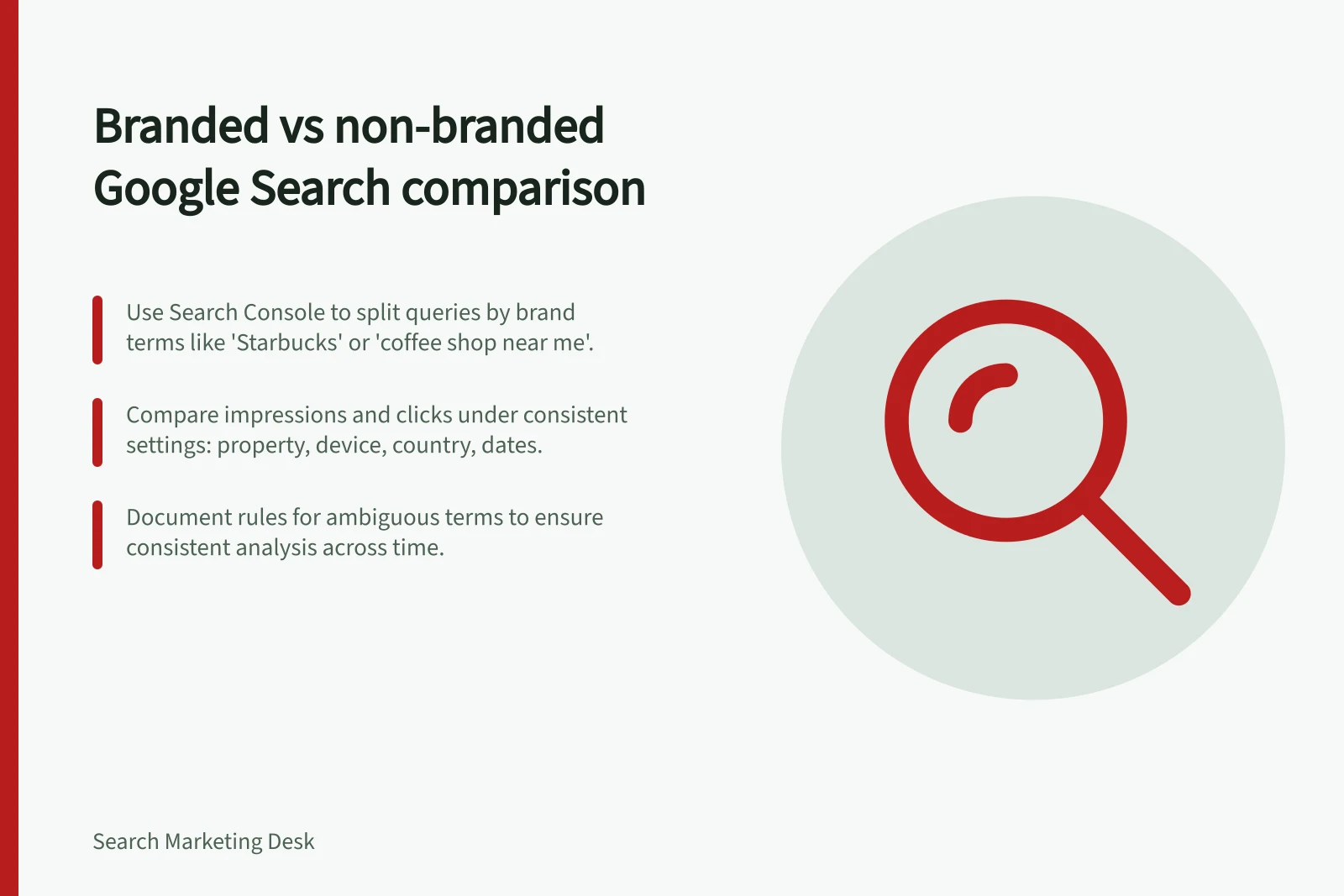
Branded and non-branded are your own query classifications, not universal categories. Write down the brand terms and how you will handle ambiguous cases, then apply the same rule whenever you compare activity.
For example, for a coffee business using Starbucks as its brand term, classify queries containing “starbucks”—including “starbucks coupons” and “closest starbucks near me”—as branded. Classify “coffee” and “coffee shop near me” as non-branded under that rule.
An ordinary word can also be a brand, and a product name may be shared. Record how you handle these ambiguous terms so the groups do not change with analyst judgement.
Compare like with like
Open Search Console’s Performance report (Search results) and use its advanced filtering and comparison controls to examine the query groups. Filter for the brand terms in your rule, then compare with queries that do not contain those terms.
Keep the property, search type, page group, country, device and dates consistent. Compare impressions and clicks before interpreting CTR, because a changing query mix can alter the rate. Then inspect the pages receiving the activity: a branded movement concentrated on a home page raises a different question from a non-branded movement across service pages.
| Observation | Question to investigate |
|---|---|
| Branded clicks rise | Did name-related impressions rise, or did selection from results change? |
| Branded clicks fall | Which queries and pages account for the loss? |
| Non-branded impressions rise | Are the additional searches relevant to an offer the business can fulfil? |
| Non-branded clicks rise | Which pages gained visits, and what happened after arrival? |
Wider promotion or awareness may accompany a branded change. A non-branded gain may include broad searches with little business fit. Check the business calendar and actual queries before drawing either conclusion.
State the data limits
Treat the branded split as an analytical grouping, not a complete explanation of search activity. The groups depend on the terms and rules chosen, so document them and avoid presenting groups based on different rules as directly comparable.
The split can show where search activity changed, but it cannot establish why. Do not assign an individual on-site action to a branded or non-branded query without a method that supports that connection.
Key Data Considerations in Branded vs Non-Branded Analysis
- Data LimitationThe branded split is an analytical grouping, not a complete explanation of search activity.
- Rule DependencyGroups depend on chosen terms and rules; document them carefully.
- Causation RiskCannot establish why changes occurred without further analysis.